How to paint your car on the cheap and still get professional-quality results in the end – it can be done!
By Richard Lentinello
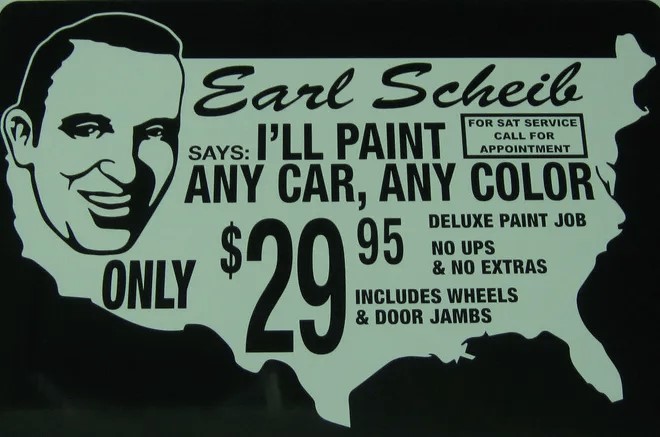
The single most expensive job of any restoration is the refinishing of the body. Besides all the expensive labor required to get the exterior metal in perfect shape and properly prepare it for the final finish, you then have to add the cost of the paint itself and all the supplies needed.
In some cases the combined costs of all the required primers, paint, thinners and hardener can actually exceed the labor cost. In fact, depending on the color and type and brand of paint chosen to make that old Mercedes or Sunbeam look like it just rolled off the assembly line, you can easily pay as much as $1,500 per gallon, although the average four-quart can of a colorful topcoat will set you back a minimum of $300; as long as it’s not red, that is. Due to their more expensive pigments, reds, oranges and yellows costs more than blues, greens and black or white.
So to avoid spending $10,000 or more for a concours-quality show finish, or even $5,000 for a really nice street-quality finish, there are several worthwhile options to consider, and not all of them mean you have to paint your car yourself, although that is the least expensive way.
For those ambitious DIYers who don’t have a garage or compressor, consider renting the use of the spray booth at your local autobody shop. Many shops will rent out their spray booth and equipment for a small fee, especially on weekends or holidays when they’re closed; although most will require you to bring your own spray gun.
If you have your own equipment but your garage is not heated, you can still obtain a fine quality finish with excellent gloss retention by heating the paint before using it. Years ago, when I painted my 1974 BMW 2002 in my parent’s unheated garage, after I mixed the paint I placed the can on a food warming tray to heat it up prior to spraying. Warm paint flows out better, which resulted in an ultra smooth finish that literally looked like glass. I did this again when I painted my Fiat 124 spider with acrylic enamel, and the red finish looked fantastic, far better than what the Fiat factory did, and it didn’t even have to be wet sanded.
Always remember that the most important step in the painting process is the cleaning stage, as even the smallest spec of grease will prevent the primer from adhering properly. I use Prep-Sol, a degreaser made by Dupont that’s a specially formulated pre-sanding solvent cleaner for removing grease, wax and silicone prior to painting, but all the other paint manufacturers have a similar product that works equally well.
If you are going to be painting in a garage with exposed rafters that are covered with dust and shelving packed with dirty car parts, buy a roll of thick plastic sheeting and drape it across the ceiling and walls to prevent any dust particles from falling onto the wet paint. Sweep and vacuum the floor the day before you paint, but whatever you do don’t wet the floor before you start painting because when the water evaporates it will trap itself under the paint, which will cause the new paint to lift.
When in doubt, spray on an extra coat of paint, or three. In your quest to obtain a smooth finish, you’re going to wet sand most of that paint off anyway, so a little extra paint is good insurance. And that’s the key to a quality finish; thorough wet sanding to remove every trace of orange peel or roughness, then buff, buff and buff until the paint looks like glass.
After allowing the Jaguar’s curvy body to dry for about two weeks, David then wet sanded the entire body using 1500-grand paper, then polished it by hand using 3M’s Finesse-It liquid polishing compound. The resulting finish was equal to that of any class-winning car at the Pebble Beach Concours.
Here’s another option for you: have either your local autobody shop, or even a Maaco shop, spray the car for you. But here’s the important part: to insure the finish will be better and longer lasting you supply the paint.