Few Dodge Chargers remain in such original shape, yet this 1971 R/T has been driven 130,000 miles and survived.

Editor’s note: The first time I spotted this all-original Dodge Charger R/T was at a cruise night in New England many years ago. So, when I started writing the book, It’s Only Original Once about unrestored original collector cars, there was no question that this incredible survivor would be included. This is the story I wrote.
The Northeast region of the United States is a venerable hot bed of interesting Mopars. Walk the show field during the 4,000-car-strong All-Chrysler Nationals in Carlisle, Pennsylvania in July and you’ll see a huge amount of many of the more appealing Mopars with license plates from all throughout New England and adjoining upstate New York. There, in the Capital Region of Albany, and its surrounding farming communities and resort towns, there are more than your average amount of significant, unrestored vintage Mopars stashed in weathered barns and warm garages.
On the outskirts of the town of Saratoga resides this incredibly well preserved 1971 Dodge Charger R/T. Its white paint, black upholstery and powerful big-block V-8 remain today just as they were sprayed, stitched and assembled nearly forty years ago. To the many fuselage Charger fans in the region who have seen this car, it represents to them an important window into how these highly collectible B-body muscle cars were really built.
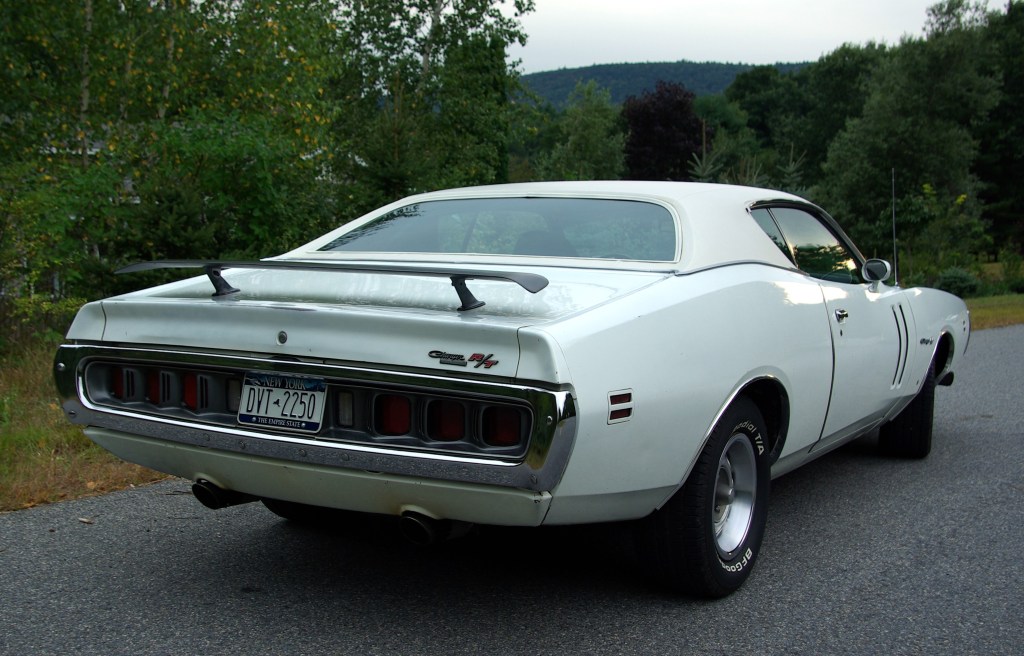
“My primary objective when I bought this car was to drive it for five years and then restore her,” its owner, longstanding Mopar fanatic, Pete Silic, said. “But so many people have told me I would ruin the car if she was restored. The more and more I think about it the more I realize they are right. The main reason I fell in love with her, besides the white color, was because she was untouched.
“There was no rust on the car at all. There are, however, more than a hundred little dents, scratches and chipped paint spots. “The interior is in excellent condition, the six-way powered Houndstooth cloth upholstered driver’s seat has some wear on it and the carpet definitely shows its age, but it all looks very satisfactory. Still, the old Dodge is amazingly presentable from ten feet away. Up close, looking at all her little imperfections is perhaps the hardest part of owning such an original car.”
Back in the 1980s, Pete owned several worthwhile Mopars, well before they were considered worthy collector cars. “I had a 1973 Dodge Charger and a 1971 Plymouth GTX when I was a kid, but I unfortunately sold them,” Pete remembers. “Perhaps this is why I wanted another Charger. You always try to get what you had when you were younger. Maybe that’s why when I’m driving this Charger, it makes me feel like I’m young again. More importantly, there’s nothing like going down the road in an old car.”

This particular Charger R/T sports the highly desirable 370 horsepower 440-cu.in. Magnum V-8 and the robust 727 TorqueFlite automatic transmission. From the Carter four-barrel carburetor and Transistorized ignition module to the plastic windshield washer water container and the black “R/T” hood striping, every component is a factory original. So, too, is the Rim-blow steering wheel and the very rare Mopar cassette player and recording microphone. And the power windows work as perfectly as the day their motors were first installed. Only the rear valance has been replaced, sometime during the car’s existence in Texas where it spent all its previous life accumulating more than 128,000 miles.
Today, Pete drives his rolling automotive artifact about 2,000 miles annually, which amounts to about once or twice a week during the summer, or when he’s driving to either the Adirondack Nationals or to shows at Lebanon Valley Raceway outside of Albany, New York. “When I’m showing the Charger at a car show and there’s the same car as mine that’s been restored, my Dodge is the one that usually gets the most attention.”


The interior is completely original to the car as well, including the upholstery of the seats, the carpeting and door panels. No doubt this Dodge had been well cared for.
And speaking of restored cars verses original cars, Pete was quite realistic about his thoughts on the subject. “When you look at a car that has been restored you don’t know a lot of time what’s underneath all that fresh paint. The car might be hiding a lot of secrets.”


The badges and decals may be worn and show their age, but the fact that they are Mopar originals and not reproductions makes the car more valuable and desirable. Look closely at the rear taillamp assembly and how poorly the silver paint was masked off. A detail such as this, along with the paint drips in the doorjambs show exactly how these cars were originally built.