During the early years of the 20th century, prestigious motoring for the sporting set was best expressed by the Pierce-Arrow Runabout.
Well-balanced design is characteristic of both its construction and its appearance.”
– Pierce-Arrow Motor Car Company
Peugeot in France, Triumph in Great Britain and Pierce-Arrow in the United States produced automobiles that were not only geographically distant from each other, but also the types of cars they manufactured were poles apart as well. Yet, all three auto manufacturers had one thing in common: They each built bicycles before turning to the manufacture of automobiles. In the late 1800s, two wheelers ruled the day.
As the automobile gained in popularity, some manufacturers chose quantity over quality by offering affordably priced cars for the masses. Others targeted the high-end market by producing automobiles that only barons, presidents and other upper-class citizens were able to afford. One such manufacturer was the pride of Buffalo, New York: Pierce-Arrow.
Before the company started designing and building cars, down by the Buffalo River on Hanover Street in the industrial part of this bustling city, a man named George Pierce started a business making all sorts of wire-laced products such as bird and squirrel cages. Not just any birdcage, but mainly lavish, finely crafted cages targeted to the wealthy. Pierce’s aspirations always concentrated on the production of high-quality items, whatever that item may have been. Being the best of its kind was his goal, and the automobiles that bore his name were created to be just that – the greatest of them all. Many of them were.
Branching out from birdcages, the next logical step for this specialist wire-forming company was the manufacture of wire-spoked wheels for the burgeoning bicycle market. This led to the production of complete bicycles – high-quality bicycles, of course. Besides the superiority of their construction, Pierce bicycles were quite advanced for their time with unique features such as shaft drive, sprung forks with spring leaves, and cushioned frames incorporating a telescopic shock absorber. In 1897, they sold for a hefty $75. Then came the cars.

Although George Pierce began selling automobiles in 1900, these were simply re-badged steam-powered cars built under license from the Overman Steam Car Company. But they were frail and hardly the type of quality automobile with which Pierce wanted to be associated. Shortly thereafter, he hired a British engineer named David Fergusson who helped him create the first real Pierce “automobile”: the Motorette. This single-cylinder, gas-powered buggy was introduced in 1901, followed by a two-cylinder version in 1902. In 1903, they introduced the Arrow, which actually looked like a real automobile.
Known as the George N. Pierce Company and growing in a slow but satisfactory manner, helped in part by their previously established country-wide network selling bicycles, the Arrow sold well with some 50 examples produced. With a list price of $2,500, this was big money considering a new house in 1903 cost $5,000 with the average annual salary being around $300.
More success followed in 1904 after Pierce introduced a powerful four-cylinder car called the Great Arrow; this was the car that put Pierce solidly on the map. Now focusing on building only four-cylinder-powered automobiles, the Great Arrow also introduced the company’s signature cast aluminum body panels that added greatly to the car’s overall solidity. Powered by either a 30- or 40-horsepower engine, they were very expensive at $5,000; however, it was this car’s numerous victories in the prestigious Glidden Tour that linked the company with greatness practically overnight.
a radiator made entirely of brass.
According to the Pierce-Arrow Society, “The first Glidden Trophy was awarded in 1905, with the winner being Percy Pierce (George’s son) driving a Great Arrow. There were 33 cars entered in the run from New York City to Bretton Woods, New Hampshire, a distance of 1,100 miles. The Glidden Tours were endurance runs with the Glidden Trophy being awarded to the most roadworthy car on the tour. Percy Pierce, accompanied by his parents, fiancée and mechanic, won the 1905 trophy scoring 996 out of a possible 1,000 points. Pierce continued to win the Glidden Trophy for the next four years.” Most impressive were their perfect scores in 1906, ’07, ’08 and ’09, with the last Glidden Tour being the longest, running from Detroit to Kansas, a distance of 2,637 miles. The company’s motto, “Luxury means efficiency always,” certainly seemed appropriate.
Success from winning multiple Glidden Tours was a huge shot in the arm for the company. Insight from The Pierce-Arrow Society states that a new factory in Buffalo opened on Elmwood Avenue, on the 44-acre site of the 1901 Pan-American Exposition, where the assassination of President William McKinley occurred. “The new Pierce factory eventually covered 1,500,000 square feet with all the modern conveniences, including a chemical laboratory, power plant, laundry, two dining rooms, and snack counters offering coffee, pie, ice cream and fruit to the employees.”
In 1908, the company officially changed its name to the Pierce-Arrow Motor Car Company, with the Great Arrow models being the first cars to be called Pierce-Arrows. Sadly, this was the year the Pierce family no longer had an ownership stake in the company; however, Percy Piece continued building bicycles and four-cylinder motorcycles until selling the company in 1914. But march forward the car company did and with great success and growing prestige, too.
One big change was the introduction of their six-cylinder engine, which would go on to power all Pierce-Arrow automobiles for the next decade. One company advertisement said it best: “Every Pierce-Arrow Car for 1910 is a six cylinder. Experience shows that only the smooth operation of the six-cylinder engine gives that real luxury of power which harmonizes with the other equipment of the Pierce-Arrow.”

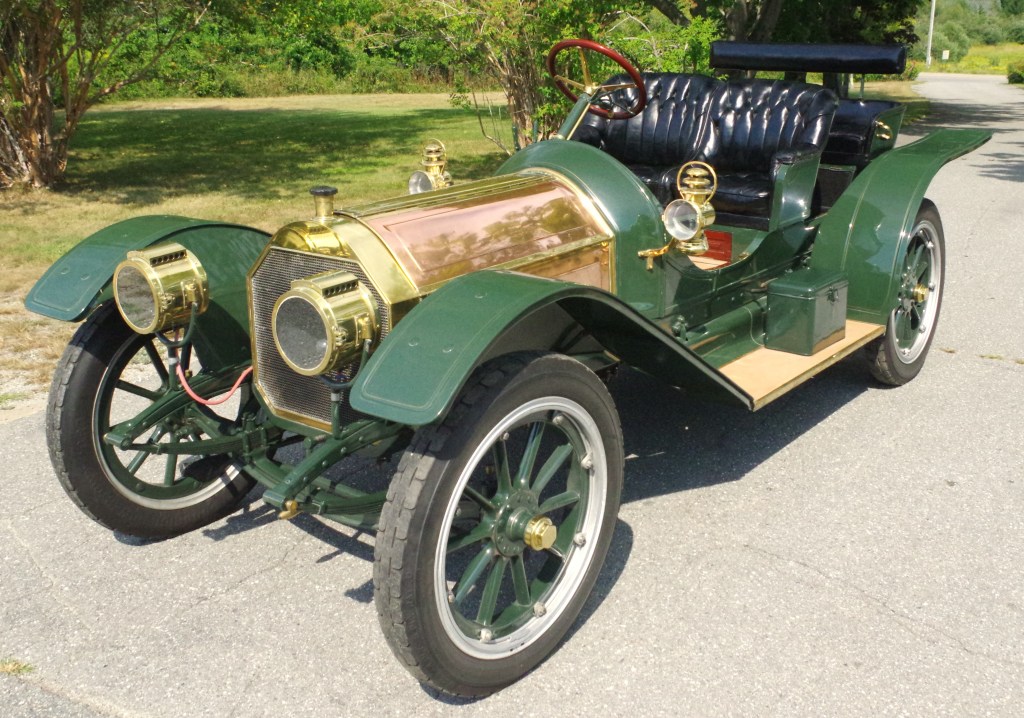
The long horizontal brass tube is the intake manifold.
Now expanding rapidly, the company offered three distinct models for 1910: the 36, 48 and 66; each number represents that model’s engine horsepower rating. The 36hp runabout was the most “affordable” with a base price of $3,850, while the top-shelf 66hp Landau listed for an astronomical $7,200.
Production numbers of each of the different models Pierce-Arrow built have been lost to time, but the few cars that have survived are highly desirable, well taken care of and lovingly admired by their devoted owners. When it comes to the early cars, one of the most sought-after models is the Runabout. A low-slung four-seater with sporty overtones reminiscent in style and shape of its competitor, the Mercer Raceabout. Whereas the Mercer had seating for only two, the Runabout accommodated three, maybe four, people – two up front and one or two in the rear.
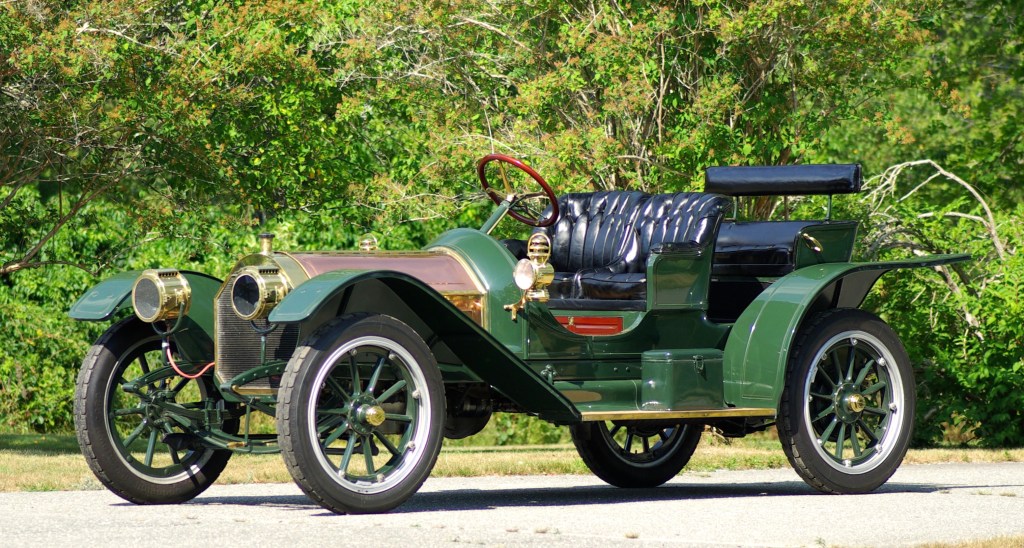
The 1910 Pierce-Arrow Runabout featured here is a model 36-UU and is considered one of the finest examples in existence. Once part of the renowned James Melton collection, it resides in the Seal Cove Museum in Seal Cove, Maine. The museum acquired the car in the mid-1960s, and its ownership is currently in the hands of Tina Paine-Weeks, the daughter of the museum’s founder.
When new this 36-UU Runabout cost its affluent owner a hefty $3,850, yet it was substantially less expensive than the larger, more expensive 48 and 66 models.
Power comes in the form of a Pierce-Arrow-designed and manufactured inline six-cylinder T-head engine. With its detachable cylinders cast in pairs, it displaces 358 cubic inches, which is equal to 5,866cc. It has a 4.00-inch bore with a rather long 4 ¾-inch connecting rod stroke and is equipped with two spark plugs per cylinder – one plug on top and one plug on the side. The spark plugs do not fire in unison. According to Tim Weiss, Associate Director of the Seal Cove Museum, “Being a dual-ignition system, the engine starts by the coil box, which feeds the starting set of spark plugs. Once the engine is running, the coil box switches over to the magneto, which then provides a much hotter spark to the other set of spark plugs. With most of these dual-ignition systems, there are two spark plugs per cylinder: one for each system. This is a common feature on cars of this vintage.”
Other features of this T-head engine are a centrifugal water pump, and an updraft carburetor manufactured by Pierce-Arrow. The carburetor has no model numbers stamped into its all-brass body except for “36 HP,” which designated the engine for which it was intended. Tim informed us: “Many of these unique carburetors have been replaced over the years, but the ‘36 HP’ clearly displayed proves this is the original.” Yet the most distinctive feature is its utilization of two camshafts – one on each side of the block. The right-side camshaft activates the intake valves, the left-side camshaft the exhaust valves.
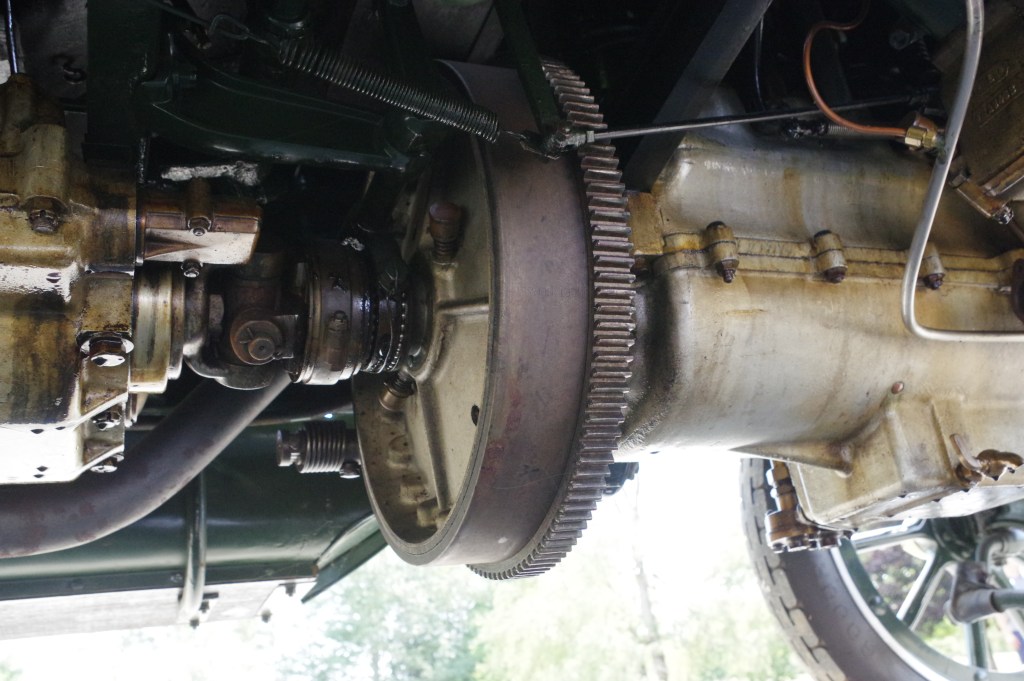
Behind the engine sits a rather heavy cast flywheel with exposed ring gear to which the starter motor engages. The transmission is a four-speed selective sliding-gear manual gearbox with reverse gear. The two-piece clutch is a cone-type assembly that’s of a conical design. It incorporates a male cone and a female cone instead of the usual clutch disk. The male cone is covered with a leather band with cork inserts acting as the friction material. When the clutch pedal is depressed, it pushes the male cone into the female cone, thus disengaging the gearbox from the engine[MS1] .
The drivetrain sits in a stout C-channel steel frame with semi-elliptic leaf springs up front and three-quarter elliptic leaf springs suspending the rear axle along with a torsion rod to control movement. Friction disc shocks are located at all four corners. Perhaps the one mechanical arrangement that could use some assistance is the brake system; drum brakes with contracting bands are fitted to the rear wheels only. The parking brake is an internal expanding type fitted to the rear drums.
This Runabout, marketed as the lower end model of Pierce-Arrow’s offerings, rode on a 119-inch wheelbase. Although sporty-type automobiles usually cost more than their sedan siblings, the Runabout’s entry-level price was due to its stripped-down makeup. There wasn’t a piece of glass of any kind, not even a windshield, and it had no doors or a trunk, no roof or convertible top. The Runabout was a no-frills automobile of the simplest kind.
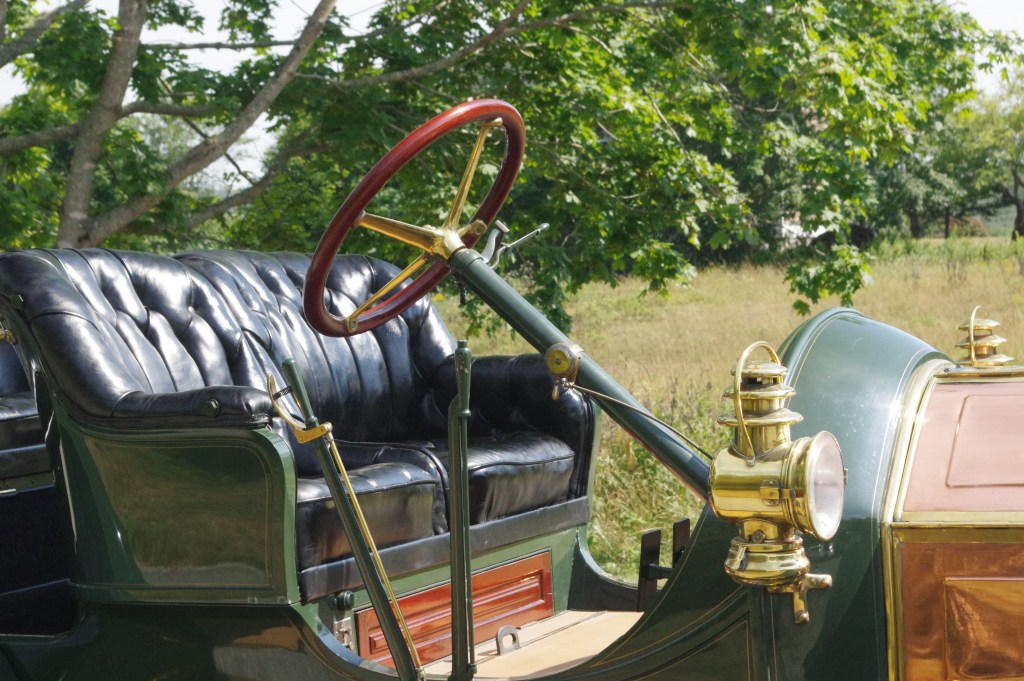
Its hand-crafted body incorporates a cast aluminum cowl, copper hood, and fenders formed of sheet steel. The main body structure is lightweight aluminum fastened to a wood frame; the floorboards are also constructed of wood. The radiator’s honeycomb matrix is surrounded by a brass shell, with two large round brass headlamps on either side. Called “searchlight” lamps, they were manufactured in Plainfield, New Jersey, by the Rushmore Dynamo Works. Originally operated by acetylene gas, they were electrified years ago with a single bulb. For additional lighting, a pair of brass sidelamps are mounted on the cowl. What empowers the Runabout with a rugged-looking stance are its tall wheels. Painted to match the car’s body, they are 10-spoke wood wheels made of hickory and feature demountable rims fitted with 34 x 4 ½ -inch 4-ply tires and small hubcaps spun out of brass. For its small size, it has an engaging big-car presence about it.
J.L. Osgood, a Pierce-Arrow engineer, has been quoted as saying: “Given no more than the ordinary care by the average owner, a Pierce-Arrow will outlast any locomotive. With all the advantages of care a locomotive has over an automobile, the latter will outlast the former, and I have no hesitancy in saying that a Pierce-Arrow should give good service for 15 years.”

how much oil is in the engine.