With loads of roomy comfort and plenty of cargo space, station wagons are the most practical car model ever created
If you had to own just one car, a station wagon would be the ideal candidate. No other vehicle is more practical, useful or as comfortable, especially so for those hobbyists who are active building things, like to go hunting or fishing, or have large families and a bunch of Dachshunds to take to the park.
With their spacious cargo area and multiple seating arrangements, you’re able to cram in loads of stuff, way more than even the largest SUV. From endless bags of groceries to fenders, doors, bumpers and transmissions that you just picked up at Hershey, you’ll be amazed as to just how many fairly large objects a wagon’s cargo area can hold. And for many models, they can haul full sheets of plywood and sheetrock, not to mention space for that SnapOn tool chest you just scored at the local tag sale. Need more room? Bolt on a roof rack and you’ll be able to tie down a complete chassis, front clip, quarter panels or one of those huge round Gulf oil signs. Yessirree folks, you can’t beat the practicality of a station wagon.
Because of Detroit’s current lack of vision, if you want to buy an American-built station wagon your only choice is to go vintage; they’re just not making new ones anymore, and that’s sad. But thanks to the great Detroit car companies of old, where every auto manufacturer produced not only more than one type or style of wagon, but they could have been ordered with different engine/transmission combinations and a whole host of other options including different color interiors, your choice for an affordable, appealing, not-too-old wagon today is quite extensive, that is, if you can find someone willing to part with their wagon; few owners are.
You don’t have to go the old car route if you don’t want to; some of the best engineered American-made station wagons were those built in the early Nineties by General Motors: the Chevrolet Caprice and Buick Roadmaster wagons feature all the desirable mechanical components that you expect in a modern car that are worthy to have for daily use, such as ABS brakes, air bags, electronic fuel injection and gas-saving four-speed automatics. The best ones are the LT1-powered models; if you want to buy a real future collectible, these LT1 wagons are it.


GM built all sorts of different station wagons through the years, such as this 1962 Pontiac Bonneville (top left), 1962 Corvair (top right), 1956 Chevrolet Nomad (center right), and this 1970 Oldsmobile Vista Cruiser.
If those GM wagons are still too old for your taste, try to get your hands on a 2005-’08 Dodge Magnum. Even without the Hemi V-8, the standard V-6 model still scoots well, handles with incredible agility and is comfortable beyond belief. With a little searching there are still a few left-overs collecting dust on a Chrysler dealer’s lot omewhere.
One mostly forgotten Chrysler station wagon model are those 1976-’80 Dodge Aspen and Plymouth Volares. Although the largest engine available was only a 318-cu.in. V-8, these cars offer a very smooth, comfortable ride with stone-tough reliability. Their cargo hold may not be as spacious as the larger GM wagons of the day, but what they offer in terms of comfort and ease of repairablity is unsurpassed. Plus, their more compact size makes them easier to maneuver on crowded highways and easier to park on city streets. Same goes for Chevy’s 1978-’83 mid-size Malibu wagon. And let’s not forget the well-styled Vega Kammback wagon too, especially the sporty GT model, the very distinctive Corvair Lakewood and the Chevy II wagons.
Reversing direction, if you can find one of those clamshell wagons with the hideaway tailgate that GM produced from 1971-‘76 you’ll have a well-built car that has very good road manners matched by reliable, durable and very affordable mechanicals. The tough part is not only finding one in decent shape but finding one for sale at all. Locating a clamshell wagon with a straight, rust-free body that’s in good condition is key because all the exterior trim parts are basically impossible to find. Good luck hunting.


The Chrysler Corporation was also a prolific builder of station wagons. Here we see a 1953 Chrysler Town and Country (top left), a 1965 Dodge Dart 270 (top right), 19688 Plymouth Sport Suburban (bottom left), and a 1957 Plymouth Belevedere Sport Suburban (bottom right).
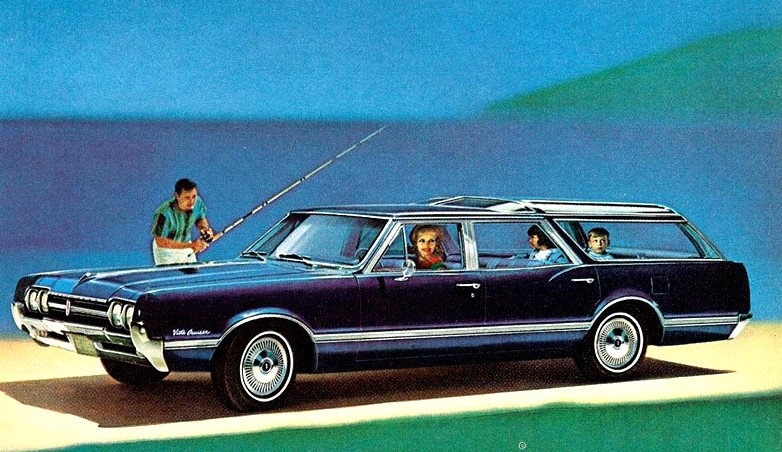
My favorite station wagon of all time is the Oldsmobile Cutlass-based Vista Cruiser of 1967; the ’66 model comes in a close second. These wagons have the look that epitomizes the unmatched character of Sixties-era American cars. Even Buick’s Skylark-bodied Sportwagon is another striking model to consider, as well as the larger Impala and Bonneville wagons.
Over at Ford, the smaller Falcon/Comet-based wagons of the early Sixties provide an exceptional alternative to those larger GM and Chrysler wagons. Most parts required to restore one are readily available, including most body and floor panels, and their smaller-sized engines are ideal for today’s soaring gas prices. And who wouldn’t want to own perhaps the most classic American wagon of all time: Ford’s mid-Sixties Country Squire.


The independent auto manufacturers produced many distinctive station wagons, such as this 1959 Rambler (top left), 1947 Nash Suburban woody (bottom left) and the very pratical 1963 Studebaker Wagonaire (bottom right) with the sliding roof.
But if you want a big wagon to schlep your kid’s entire little league team to the ball field, or if you have a Donzi speedboat to trailer, consider an early Seventies Plymouth Fury wagon with a 383 or 440 V-8 under the hood. You’ll have power aplenty to tow practically anything, and you’ll do it in total comfort.
For lovers of Independent makes, Studebaker’s Wagonaire just may be the most practical wagon of all time. With its rear-opening roof section, its ability to transport large objects that are also tall is unsurpassed. And wouldn’t an AMC Pacer wagon be a fun car to cruise around in too?


The Ford Motor Company built some of the most popular station wagons ever, such as the 1958 Ranch Wagons (top), shown here in both two-door and four-door configurations, and the 1967 Mercury Colony Park (bottom right). Pontiac produced this Chieftain Deluxe wagon for the 1953 model year.