How America’s society changed for the better through the development of the automobile
By Richard Lentinello
Safety glass, rubber tires, carburetors, pistons and shocks. These are just a few of the thousands of mechanical innovations that came about due to the creation of the automobile.
With a production period that has already spanned more than 100 years, the automobile remains today at the forefront of noteworthy technical achievements. Some of the more recent ideas that have emerged as a result of man’s quest for safety, efficiency and performance are the air bag, computer-controlled electronic fuel injection, run-flat tires and compact global positioning systems.
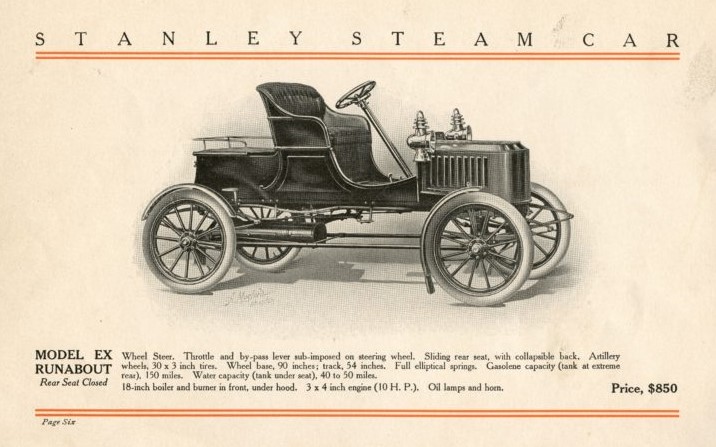
Like most remarkable objects that are incessantly redesigned and refined until the end result meets, and often exceeds, the goal of the initial concept, the blueprint for the automobile actually started out as one man’s crusade – in this case, to produce a self-propelled steam-powered carriage. That man was Oliver Evans. The year: 1772.
With the outset of the Revolutionary War looming in the not-too-distant future, a young twenty-something Evans focused all his creative energies on the creation of the steam engine which would be used to power flour mills and wagons. Unfortunately, because the United States Patent Office was still a few years away from being established, Evans never was able to secure the proper protection for his steam-powered inventions, despite the state of Maryland’s approval for patent protection in 1787.
Then in 1791, George Washington and Thomas Jefferson signed the document giving Massachusetts’ Nathan Read, a graduate from Harvard, the patent to a high-pressure boiler. Read had drafted plans in 1790 for a steam-powered land carriage using two such engines, one driving each wheel.
Not to be outdone, Oliver Evans then designed a reciprocating steam engine and a rotary engine. Although the rotary engine was never patented, Evans did receive a patent for his ingenious steam engine, which employed the use of 100 pounds of pressure per square inch; this use of high-pressure steam was unheard of and was condemned by noted British inventor James Watt.
Although documentation exists that proves several steam-powered land carriages had been built and driven prior to 1850 in the United States, it wasn’t until 1851, with the official launch of the American Steam Carriage Company in New York City, that the first serious steam-driven carriage manufacturer was founded.
Inventor William James is credited with the creation of several steam-powered wagons, one of which was powered by a two-cylinder reciprocating engine and driven on the streets of New York City back in 1829. Later on, in 1851, the experienced steam engineer, John Kenrick Fisher, joined the American Steam Carriage Company and duly built a carriage that had a top speed of 15 MPH.
Steam wasn’t the only means of motivation being tried. Besides experiments with compressed air and gas, Samuel F. B. Morse, the inventor of the electric telegraph in 1832, was tinkering with the concept of an electric motor. But the honor of inventing and patenting the first electric motor goes to Vermont native, Thomas Davenport, whose main profession was that of a blacksmith. Davenport’s motor design instituted the first configuration of a commutator, the same concept that is used in electric motors today.
As a result of Davenport’s experimentation with the electric motor, Moses Farmer of Massachusetts bolted an electric motor onto a carriage in 1847 and became the first unofficial electric car “builder”. While Farmer’s electric carriage was powered by 48 Grove cells and able to carry two people, shortly thereafter Washington D.C. professor Charles Page was able to transport 12 people along the W&B railroad at 19 MPH by using a more powerful 16 HP motor driven by 100 Grove cells. Mr. Page later went on to invent the Page ignition coil.
While many inventive minds continued to perfect their own versions of steam engines and electric motors throughout the 1800’s, in a shop in New York City an engine of a totally different design was being developed. The theory behind this engine is the foundation of the engine that powered the car that transported you to work and back home today: the internal combustion engine.
Starting in 1835, Alfred Drake of Philadelphia developed an engine over a 20-year period that brought into existence the principles of internal combustion. Unlike other internal combustion engines that had been previously designed, Drake’s engine had a unique feature: a primitive ignition system in the form of heated tubes which in turn were used to ignite the fuel mixture. Several patents were issued as a result of Drake’s ingenious ignition.
But the most effective internal combustion engine design up until this point in time was that of Stuart Perry. Patented in 1844 and 1846, Perry’s engine was engineered and built in New York City. Very much like contemporary internal combustion engines, this two-cycle engine was of a vertical design and had a cylinder head with separate inlet and exhaust valves. Other traditional features included a piston and cylinder, camshaft, water pump, throttle valve, igniter, and a lubrication system.
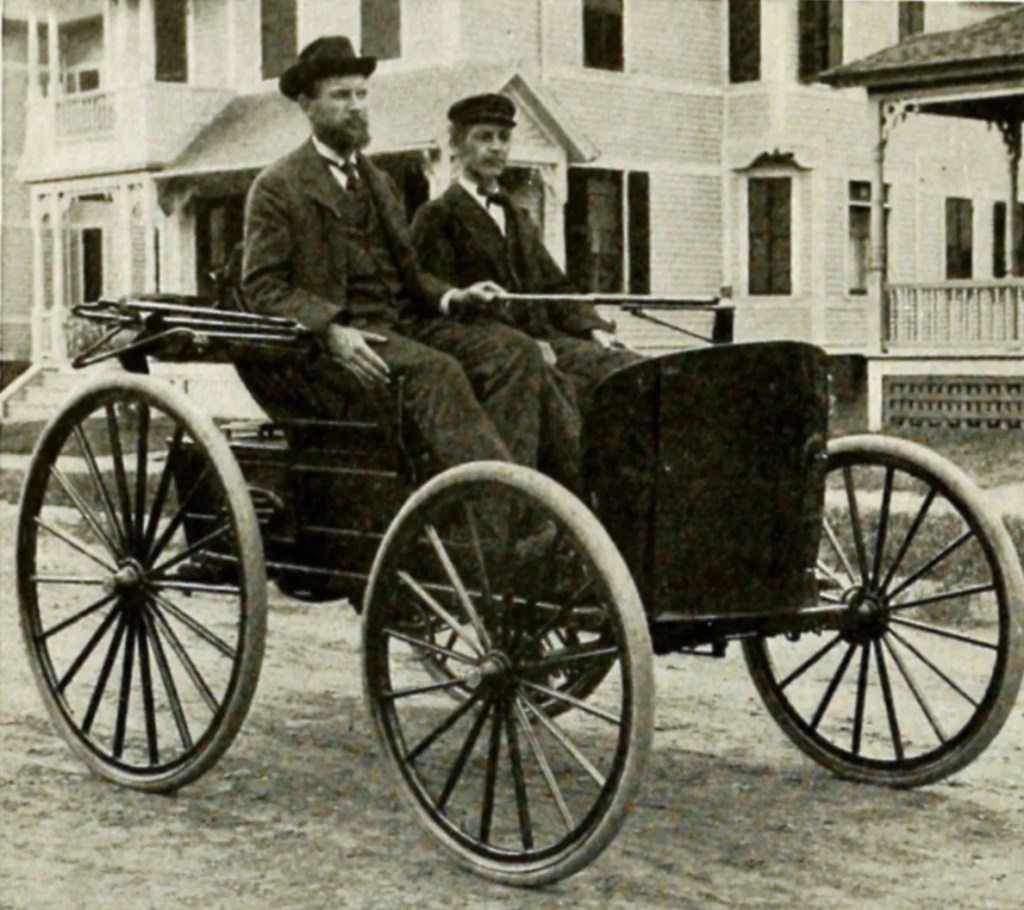
Applying this engine theory as the keystone behind the construction of a self-propelled vehicle, who has history actually credited with the building of America’s first gasoline-powered car? Many experts are in agreement that Charles Duryea built America’s first gasoline-powered car in the 1890s. Others cite Elwood Haynes’ automobile of approximately the same time.
The man who deserves perhaps the greatest amount of credit for perfecting the gasoline-powered internal combustion engine – and thus forging the way for the mass production of gasoline-powered automobiles – is German engineer Nicolaus August Otto. It was Otto’s four-cycle design that transformed the internal combustion engine into a viable means of motivation for the masses. Having been granted a patent on August 14, 1877, the principles behind this engine are what is commonly referred to as the Otto cycle engine.
Since the early 1800s, as the automobile progressed from experimental backyard carriages to modern, high-tech computer-controlled machines capable of speeds in excess of 200 MPH, they have brought together similar creative-like minds. Individuals with visions and the desire to make things happen. Because of these talented, goal-oriented designers, engineers, craftsmen and industrialists, the world has progressed farther during the last century than any century before. And the simple reason is the invention of the automobile. Here’s why.
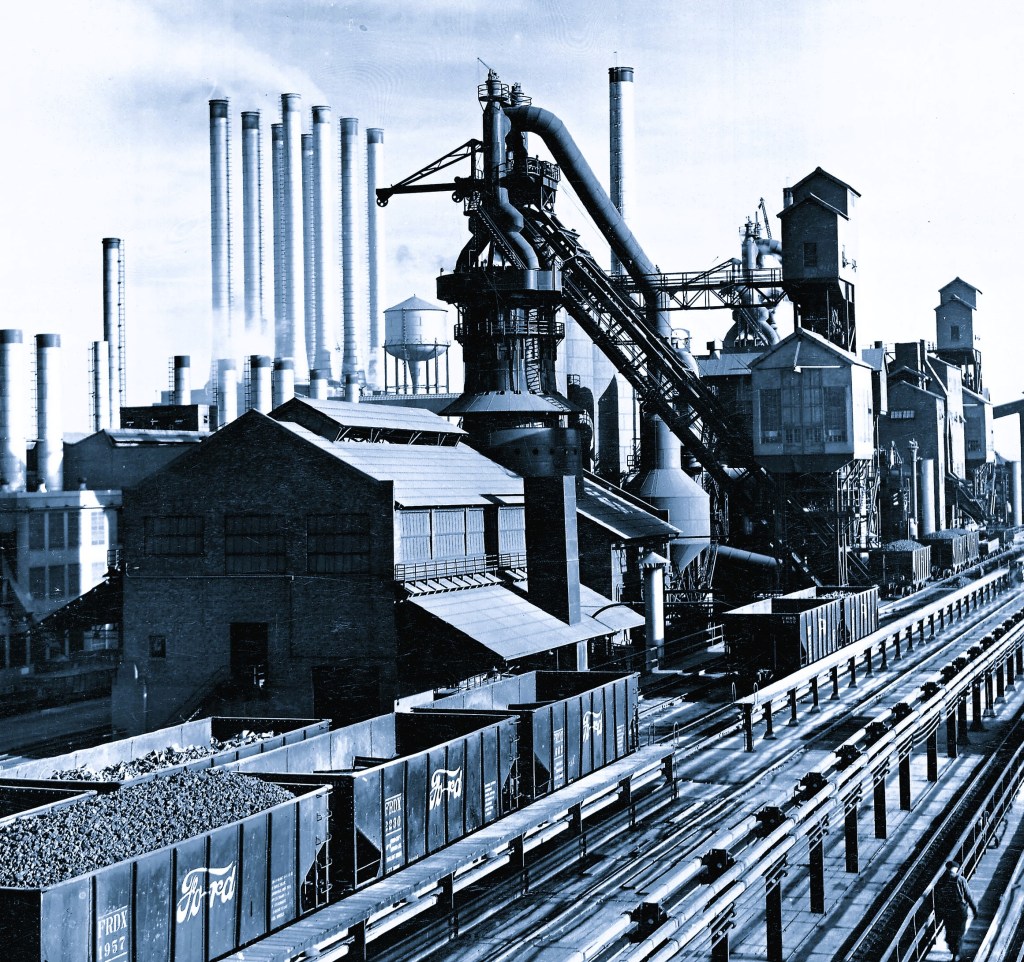
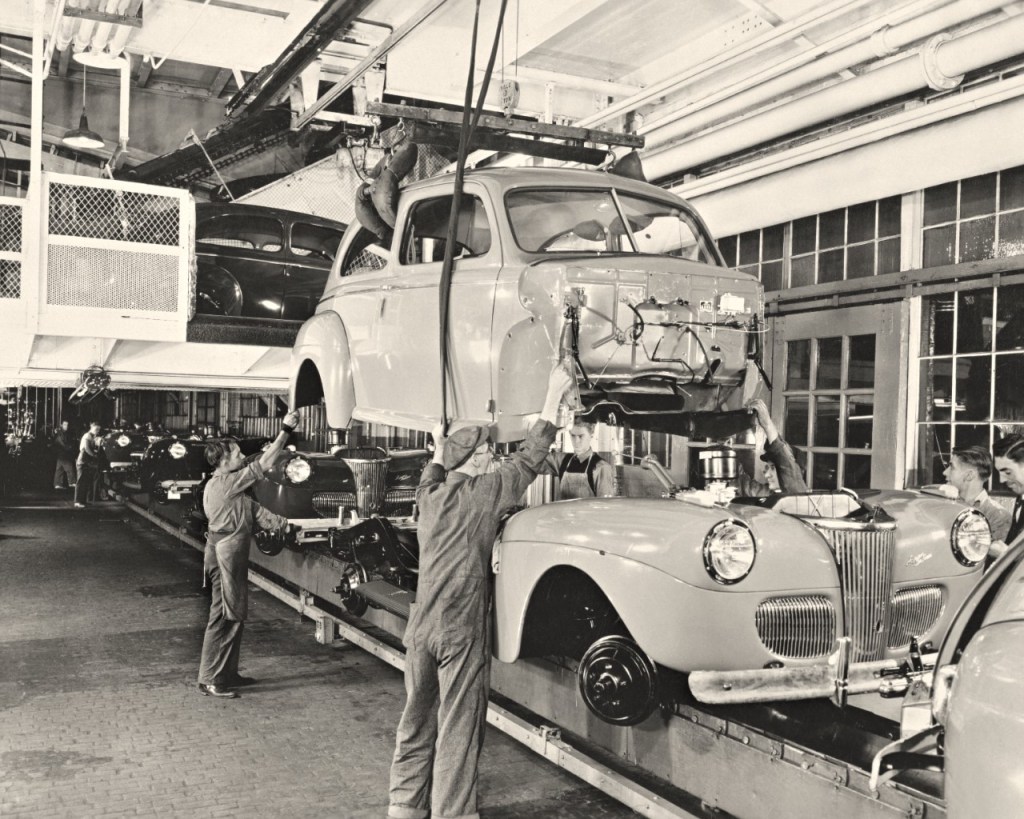
When Henry Ford perfected the idea of mass-producing automobiles on a production line, a concept that was invented by Ransom Olds, he created the need for specialized tools and heavy-duty machinery. As a result, machine tool manufacturers soon developed more efficient methods of manufacturing parts, and in-turn created specialized tools thus fostering a need for better, and different, raw materials.
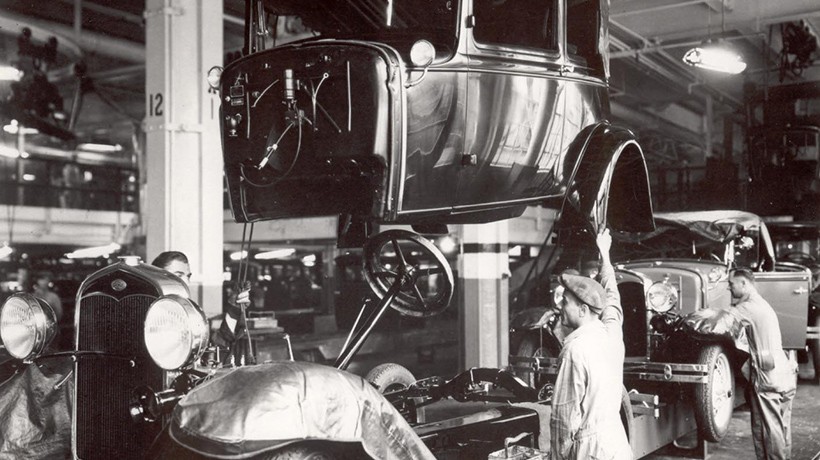
(photo courtesy of the Ford Motor Company)
Consequently, the steelmaker, because they too had to meet the fast-growing demands placed upon society by the automobile, developed better, more modern manufacturing processes, not to mention additional steel mills. The building of new mills created thousands of jobs for construction workers, carpenters, electricians and plant workers. The need for new plants created opportunities for more engineers, hence the proliferation of engineering schools throughout the country and the creation of new jobs for teachers.
Authors too were in great demand to write much needed books, repair manuals, dealer brochures and owner’s handbooks. This resulted in the expansion of the publishing industry to meet the fast-growing demand for new print products, thus increasing the demand for forestry, paper mills, printing presses and ink producers.
Most importantly, to distribute these products in the most efficient manner possible, the growth of the commercial transportation industry soon paralleled that of the automobile, resulting in specialized boxcars, hoppers, flat cars and rail cars, not to mention more powerful diesel locomotives to safely transport cars and raw materials required for automobile manufacturing.
Where trains couldn’t travel, trucks did. Manufacturers such as Day-Elder, Divco, Mack, International and Sterling are just some of the better known truck builders that were founded to produce distinct types of trucks to meet specific transportation needs bestowed upon them by the automobile manufacturers, and by society in general.
As the automobile progressed through the early part of the 20th century, new car manufacturers sprung up overnight like mushrooms. To keep ahead of the competition, manufacturers introduced new innovations on their automobiles, hoping to capture the fancy of car-hungry buyers everywhere. These innovations made cars more reliable, durable, safer, faster, more efficient, and more comfortable with each passing year.
From small-displacement, low-compression, four-cylinder engines of the early 1920s to the massive V-12s of the 1930s to the big-block V-8 torque monsters of the late-’60s muscle cars, man’s insatiable desire for more horsepower has led to the discovery of numerous mechanical marvels, many of which have been incorporated into the car that’s parked inside your garage.

There has been an enormous amount of componentry specifically designed to accommodate the requirements of the internal combustion engine. These parts include: the engine block, crankshaft, piston, connecting rod, camshaft, lifter, rocker arm, pushrod, valve, carburetor, intake manifold, exhaust manifold, generator/alternator, voltage regulator, water pump, oil pump, fuel pump, starter, distributor, coil, ignition wires, spark plug, flywheel, and, of course, bearings, gaskets, filters, belts, hoses and assorted fasteners. These same components are used in engines that power airplanes, boats, trucks, trains, tractors and other farming machinery, lawn mowers and chain saws, as well as in industrial engines which are needed in power generating plants, chemical plants, oil refineries, bridges and dams, all of which effect our lives each and every day.
The gearbox/transmission is another great innovation. From it developed the clutch and pressure plate, torque converter, valve body, hypoid gears, and synchromesh. Far removed from yesteryear’s basic two-speeds, today’s transmission has as many as eight forward gears, which contribute to longer engine life and reduced gas consumption.
With the advent of additional horsepower through the years, brakes played an even more important role than ever before. Thanks to Jaguar’s pioneering use of disc brakes on their D-Type race car during the mid-1950s, cars are safer to drive than ever before.
This same disc brake innovation has been adopted for use on motorcycles, buses, trucks and numerous recreational vehicles. Although the design was first developed for the aviation industry, nearly all of today’s cars incorporate some form of anti-lock brakes. Mass production of the automobile has resulted in a safer and more effective system, with the added bonus of reduced highway fatalities.
Other less obvious developments that are directly attributed to the automobile are ball joints, tie rods, shock absorbers, coil springs, fiberglass leaf springs, rack-and-pinion steering, universal joints, miniature fuses, specific electrical connections, lightweight alloy wheels, posi-traction differentials, safety glass, electronic fuel injection, on-board diagnostic systems, and different types of instrumentation, including, of course, the speedometer and tachometer.
We have the automobile to thank for the success of the pneumatic tire. Pioneers like Harvey Firestone developed inflatable tires to make cars ride smoother, which helped increase automobile sales.

Inside the Firestone factory in Akron, Ohio. (photo courtesy of Firestone)
Due to ever-increasing emission standards, the automobile is forever linked to the catalytic converter, oxygen sensor, air pump, and the electronic control module. The control module is designed to adjust the engine’s ignition timing thousands of times every second to ensure that the smallest amount of hydrocarbons are released into the atmosphere.
Thanks to Otto’s four-cycle internal combustion engine and the contributions of pioneers before and after him, the automobile has transformed society, and made it a better place for everyone.