How automotive headlamps have greatly improved a driver’s vision of the dark road ahead
As the automobile evolved, so did its mechanical and electrical components. While those components gradually through the years increased a car’s performance and efficiency, other components were continually improved upon to enhance a car’s drivability and safety factor. The headlamp is one such element and is without question one of the most fundamental components of an automobile.
During the automobile’s infancy it relied on candles in handheld lamps, which it inherited from the horse drawn carriages that preceded it. Although highly ineffective, a better lighting source emerged in the form of oil. Some lamps, most of which were made of brass, used either kerosene, colza oil, fish oil, acetylene, and in some cases, gasoline itself. In recent years halogen and xenon gases have been used to brighten the road ahead of us.
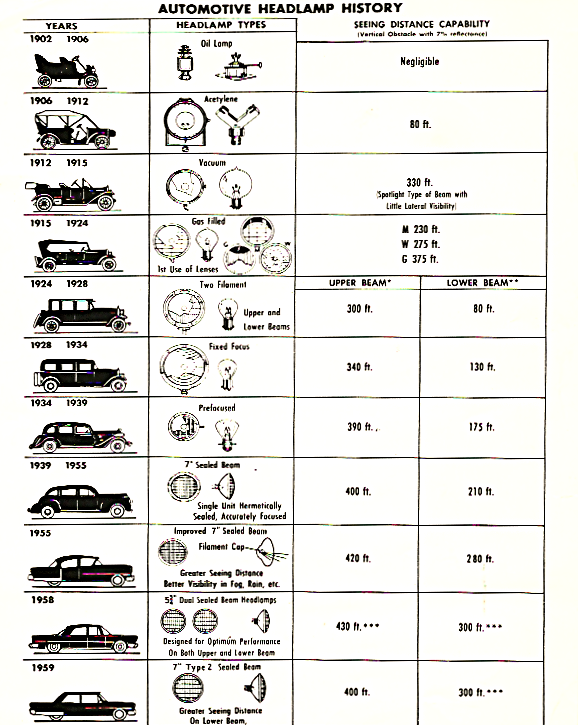
Although specially cut-glass lenses increased the seeing distance of gas-filled lamps, it wasn’t until 1924 when electric headlamps with filament bulbs were introduced that drivers were able to see so much better.
This chart shows the diverse types of headlamps used in automobiles and what their seeing distance capability was. But if this chart was updated to include a modern car’s LED headlamp, depending on that headlamp’s lumen output, they can light up the road at a distance of more than 800 feet. Now that’s progress!