How to achieve a show-quality finish without going to great expense
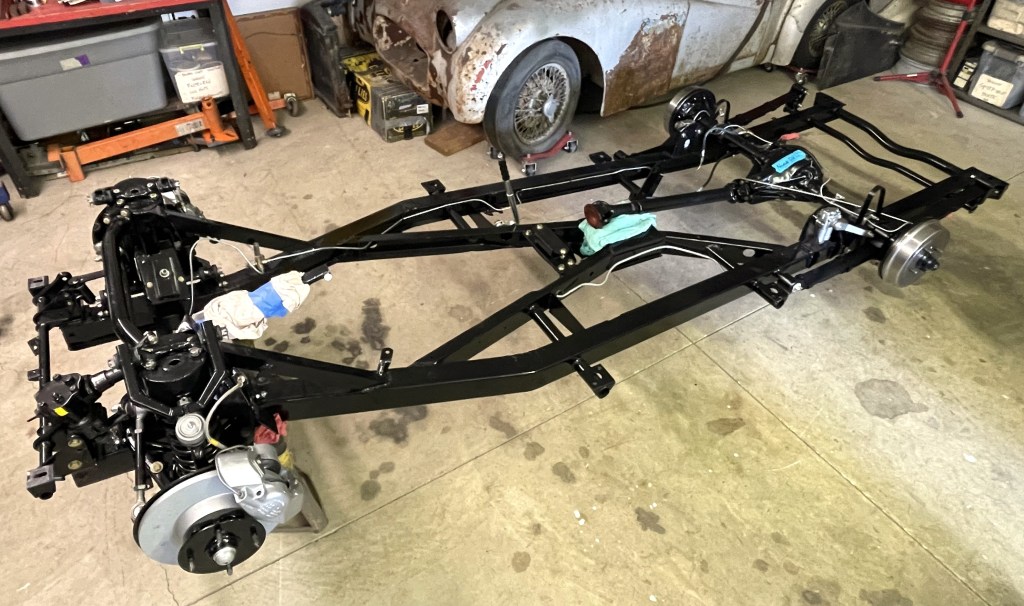
If you plan on performing a ground-up, body-off restoration, when the time comes to restore your car’s frame you basically have only two options: paint or powder coat. Both finishes have their advantages and disadvantages.
If you plan on performing an authentically correct restoration, with the entire car restored exactly how it rolled off the assembly line when it was first built, then powder coating the frame is not an option due to the simple fact that powder coating was never used on frames. But if you’re more concerned about durability and long-term preservation than 100% authenticity then powder coating should be considered.
Applied in a dry state then baked in an oven, powder coating is far more durable than paint as it doesn’t chip or scratch as easily. If it isn’t applied correctly, or if the frame’s surface is not 100% clean of grease, dirt and other contaminants, the powder coating can lift off, thus allowing moisture to get in underneath and start the cycle of corrosion once again – this is also true for paint. For mere aesthetics, there’s no denying that a powder coated finish is superior due to its level, uniformed finish that’s free of any orange peel, overspray or runs.

I was then able to rotate the frame, slowly and carefully.
Depending on its type, paint on the other hand can also be extremely durable, especially urethane enamel when mixed with hardener. Prior to the application of the topcoats, a few coats of epoxy primer are essential for maximum adhesion. And if a few clear coats cap off the refinishing process, then the frame’s finish should be just as hard-wearing as powder coating.
Autobody paints are not the only type of paints to be considered for refinishing a frame. While nearly all autobody-specific paints can be very costly, I’ve seen many excellently refinished frames and firewalls refinished with off-the-shelf Rust-Oleum. Their black enamel comes in a semi-gloss that is almost identical to the semi-gloss that the auto manufacturers used, and it’s fairly inexpensive. Rust-Oleum also makes a line of industrial coatings that you should consider refinishing your car’s frame and suspension components with, as it’s resistant to chemicals and designed to prevent chipping and cracking. Other extremely durable industrial coatings, the type that are used on oil platforms, in factories and on bridges over salt waterways, make excellent finishes too, however, I don’t believe this type of paint is sold in one-gallon cans, with five-gallon cans most probably being the smallest size. Another alternative are the rust inhibiting coatings, such as Chassis Saver and Por-15, both of which can be applied over corrosive metal.
Believe it or not, I once had seen a perfectly restored frame that had been painted using aerosol cans. While a quality spray gun is the preferred method of applying paint in a professional manner, if you take your time, clean and prepare the frame properly prior to spraying, you’ll be amazed as to what you can achieve with aerosol cans. This particular frame had been given several coats of semi-gloss black, wet-sanded in between, resprayed with a final coat of black before being topped with two coats of clear. It looked fantastic, with a show-quality finish to it. So don’t think you need big money equipment to get the job done – you don’t. Just perseverance and patience, and you will succeed.
Of course, the one main advantage of using paint instead of powder coating is that you don’t have to transport the frame to the powder coating facility. You simply refinish the frame right there in your garage. If you take the paint route, you will need to devise a way to hang the frame from the garage ceiling (first check to make sure the ceiling joists are strong enough) or bolt the frame to a rotisserie. In the past I’ve used a strong steel chain on the far ends of the frame; a simple bolt through one of the frame’s holes to keep the chain off the frame itself is all that’s required; however, a strong nylon rope with the proper strength rating will work just as well. I prefer the chain method because then you can extend the chain to the floor where it will act as a ground, thus preventing static electricity. The positive-charged dust particles in the air can easily ruin your paint finish, so always “ground” the frame, and the entire car too should you decide to paint the car yourself. I truly don’t know if there’s any truth to this old wives’ tale, but why take the chance?