Even after 70 years, the Corvette is still the embodiment of American muscle, driving excitement, and the freedom of being different

enthusiasts and collectors the world over.
The sexy, wind-cheating fiberglass body and the powerful, earthshaking V-8 that it hides are just two of the countless reasons why millions of car enthusiasts across the world are obsessed with the Chevrolet Corvette. The Corvette is a feast for the senses: its racy silhouette and cozy interior combine with fierce acceleration and road-hugging handling to create a unique and exciting driving sensation punctuated by the staccato rhythm of the engine’s potent rumble. To touch it, sit in it, or drive it is to become hooked for life. In simple terms, the Corvette is an icon – America’s symbol of road supremacy.
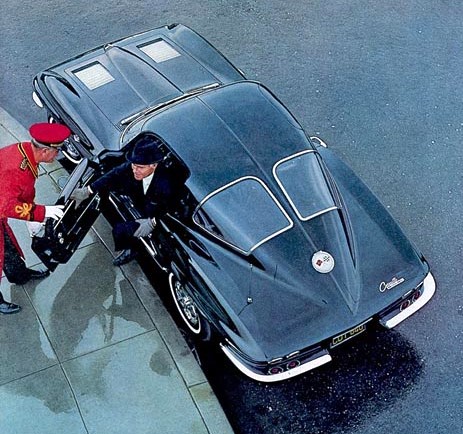
Ever since the Corvette’s debut at General Motors’ 1953 Motorama, held in New York City’s posh Waldorf-Astoria Hotel, car enthusiasts have been crowding Chevrolet showrooms across America to sneak a closer look. Through the year the shape of the Corvette has evolved from a Fifties-era cruiser complete with subtle tailfins to the graceful aerodynamic form of the contemporary mid-engine C8. In between we welcomed the awe-inspiring Sting Rays of the mid-Sixties, the sleek contours of the second-generation Stingrays of the 1968-’82 era, the streamlined fourth-generation models built from 1984 to 1996, and the high-tech C5, C6 and C7 era that began in the 1997 model year. While each of the eight generations is distinctly different from the next, a family resemblance of artful styling cues ties them all together, maintaining that special Corvette look that is prevalent in every model that Chevrolet has produced. The long front hood, the front fender side vents and side coves, the fastback rear, the four individual round taillamps – these are the hallmarks for the Corvette style.
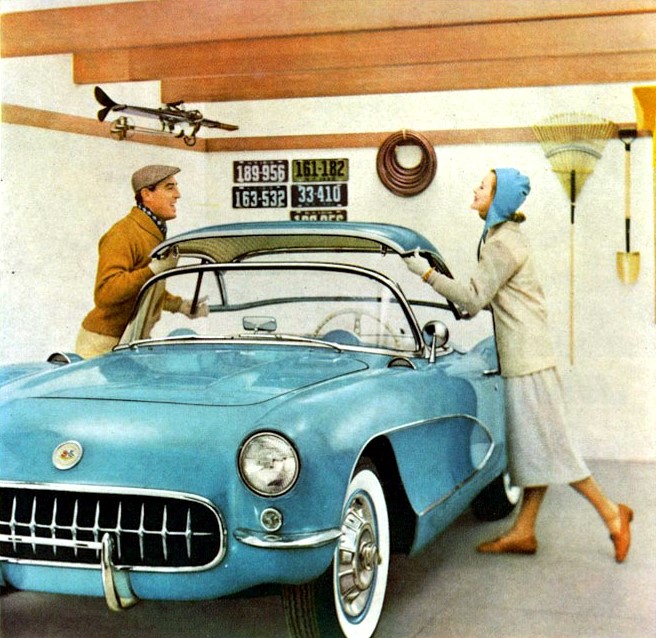
but more like a loveable member of the family.
Adding to the mystique of these beautiful, powerful sports cars is the fact that they are a relatively rare sight on the road. With an average annual production total of only about 25,000 since its inception, the Corvette’s numbers are fairly limited in comparison to other domestic cars. The car is already a standout amid your average road fare; its limited production makes it more captivating. A speeding Corvette – driving past, hugging the ground with its engine growling – commands attention, respect, and even awe from everyone it leaves in its wake.
As if to laugh at the laws of economics, the Corvette has remained remarkably affordable despite its scarcity. From its potent V-8 engine – which develops huge amounts of horsepower, torque, and neck-snapping acceleration – to its stable, gluelike cornering ability, the Corvette has consistently delivered the high performance of an exotic European sports car for the price of a fine domestic one. Perhaps this is the secret behind Corvette’s status as one of the most successful sports cars ever made.
As compelling as a Corvette is on the highway, it is on the racetrack that it really thrives. Corvettes have claimed victory after their hard-fought battles at speed on thousands of occasions. From the high banking of Daytona to the twisting road courses like Riverside, Sebring, Watkins Glen and Road America to the ultimate endurance test of man and machine at the 24 Hours of Le Mans in France, Corvettes have chalked up numerous class wins and overall victories through the years on both professional and amateur levels of motorsports competition. And in quarter-mile action, Corvettes have literally ruled the drag strips of America since the 1950s with their massive amounts of tire-shredding horsepower and asphalt-melting torque providing blindingly quick acceleration.
The Corvette has enjoyed a long lifespan of competition success, due in no small part to its amazing tough-build quality and nearly bulletproof V-8 engines. Although there have been many engines available through the years (including an inline-six from 1953 to 1955), both Corvette’s small-block and big-block engines are engineered with some of the finest yet simplest design features, which help them maintain long-term durability regardless of how much their owners abuse them. Some of these special engine features include a five-bolt cylinder head pattern surrounding each cylinder to ensure maximum sealing of combustion gases and to minimize cylinder head warpage, meaty internal oil and water passages to prevent overheating, and an ideal ratio between bore and stroke dimensions and crankshaft journal width for optimal performance. If ever there was a “perfect” engine, the Chevrolet small-block V-8 is it.

Some of the other specially designed mechanical components that have remained unique to the Corvette include a fully independent rear suspension that is sprung via a transverse mounted leaf spring. For the 1981 model year, this leaf spring was replaced with a single fiberglass reinforced monoleaf spring, a design so effective it was used on the 1999 Corvette’s front suspension as well as in the rear.
Yet the construction feature that has from the beginning set the Corvette apart from all other automobiles is its unique fiberglass body. The use of fiberglass was completely revolutionary in 1953, but its light weight and the fact that it would remain completely free of rust and corrosion quickly garnered fans. The Covette’s shell is also safer in an accident than steel, as fiberglass can absorb far more of the force of an impact than steel can. Despite some difficulties involved in working with the material during the early years of production, the fiberglass shell quickly became the hallmark of the Vette and has been a much-loved feature of every model built since.
This combination of a body that doesn’t rust, a simple engine design, and basic mechanical underpinnings has endeared the Corvette to the hands-on do-it-yourself crowd, the tinkerers and tuners who thrive on bringing their sports cars up to new levels of performance. Corvette maintenance is a straightforward exercise that many owners find very satisfying.
Of course, the early models have special appeal. Disassembling an old Corvette down to its bare chassis and rebuilding the entire car with new components, new paint, and a new interior can be extremely rewarding, and restoration of older Vettes is a hobby that borders on obsession. An entire industry has been built around supplying aftermarket parts to Corvette owners with everything needed to rebuild the perfect beast: new body panels, engine and suspension components, chrome trim, wheels, and even upholstery kits.
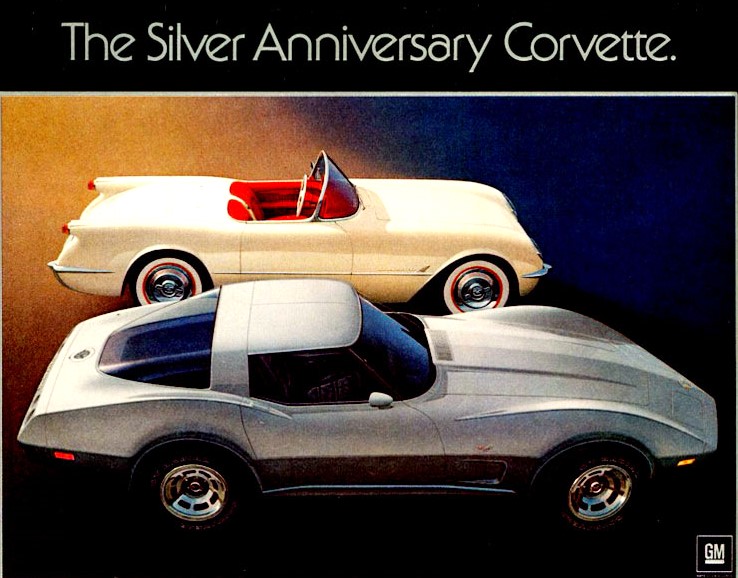
Corvette ownership is like an addiction. Many enthusiasts, after sampling firsthand the thrill of owning the most fashionable automotive statement ever created, find themselves wanting to drive, tinker with, and, yes, own more than one. With eight different generations of Corvette models to date – each providing its own unique level of driving characteristics – many fans crave at least one of each model so they can savor the taste of the Corvette experience as it developed through the years. Other enthusiasts are drawn toward only specific models from a particular generation. Still others desire only convertibles or those models with big-block engines. The focus of a Corvette collection can be as diverse as the cars themselves.
Like many addictions, the Corvette is an indulgence that is savored in groups. With several hundred Corvette clubs scattered throughout the United States, Canada, Asia, Europe and Australia, Vette fans don’t need to go far to find a fellow aficionado. Shows, rallies, races, and even weekend cruises bring Corvette lovers together; through newsletters, magazines and websites, members share tips on maintenance, preservation, restoration, and repairs.
The Corvette isn’t just a car. It is a cornerstone of automotive innovation, an instantly recognizable icon of fun, freedom, and muscle on the American road.

in production through 1996.


The 1986 Corvette paced the Indianapolis 500, and every one of the 7,315 convertibles built that year were designated pace car replicas. When the fifth-generation 1997 models came out, Chevrolet celebrated the Corvettes legacy to help built interest for the new model.

the Goo Goo Dolls to promote the car.


The last iteration of the front-engine Corvette was the C7 (left), which was in production from 2014 to 2019. Then, after many years of teasing enthusiasts with a mid-engine Corvette, it finally happened with the release of the 2020 C8. This blue 2024 Corvette showcases the car’s aggressive stance and world-class performance.