Tri-tone paint scheme and leather interior made the Fireflite-powered 1955 Coronado De Soto’s most prominent model.
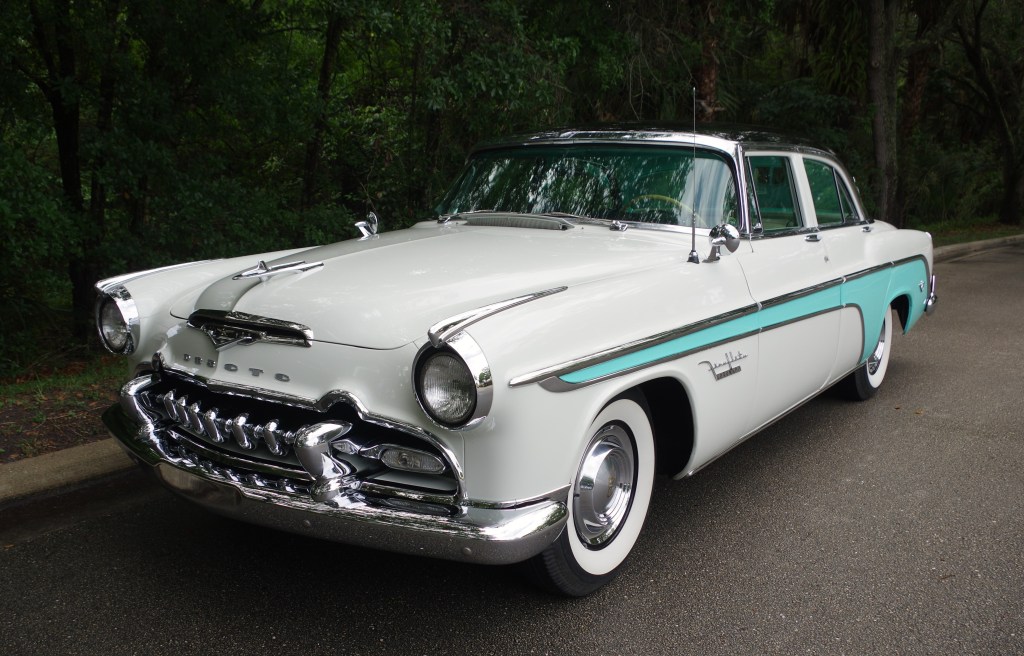
Back in the 1950s, automobiles exhibited incomparable styles all their own. There was no mistaking a Ford for a Dodge; a Mercury for a Pontiac; a Cadillac for a Chrysler. These were the glory days of automotive designs that exhilarated your senses with bright, bold color schemes and bodies adorned with unique features that quickly developed into signature attributes. For instance, Buick had their ventiports; Cadillac had their fins; Pontiac had their Silver Streak hood trim. And De Soto had their captivating toothy grilles.
The foundation of De Soto’s legendary toothy grille started with the 1950 model, which had 26 individual vertical bars. It wasn’t until the introduction of the 1951 models with their nine vertical bars did De Soto’s toothy grille really come into its own. The nine “teeth” lasted through the 1954 model year, then were reduced to seven teeth for the more modern looking 1955 models, although it did have two larger “bumperette-style” teeth on either side of the main grille. This was the last year for any type of toothy grille, as more contemporary looking screen-style grilles came into vogue for the 1956 model year. But oh, how we love those teeth – then and now.
While 1955 may have been De Soto’s last year using its toothy grille, it was also the first year of the more modern “Forward Look” design theme, courtesy of the ever-creative designer, Virgil Exner. Compared to the previous year’s models, the 1955 De Soto – and all of Chrysler Corporation’s entire lineup for that matter – were transformed into cars with far more modern-day styling that had a higher level of visual appeal. Their most notable features being their wraparound windshields and lower, wider proportions. They had a handsome aura about them coupled with a muscular manner and a confident stance that made them so attractive.

There were two model series in De Soto’s lineup: the base-level Firedome and the top level Fireflite. Within the Fireflite series there were three different body styles: the four-door sedan, two-door convertible coupe, and two-door Sportsman. Buyers who preferred the four-door model could choose from the standard Fireflite sedan or the better-appointed Coronado. Not only was the Coronado the more upscale sedan model, but also it was the only De Soto available with a factory-painted tri-tone color scheme. The three colors were white, black and teal, and could be arranged in any order by the buyer. Between the main body, roof and side sweep panel, a total of six different color combinations could be had. The Coronado was also embellished with soft leather upholstery, which added to its upmarket character.
The original buyer of our feature car chose the body of his Coronado to be finished in white with the side color sweep panel painted bright aqua, and the roof painted black. The result is oh so ‘50s, with the paint scheme creating the illusion that the 217.9-inch-long body is shorter and lower than it actually is. Of all the beautiful automobiles that came out of Detroit during this period, the Coronado is considered to be one of the most attractive. Clearly, it’s easy to see why.
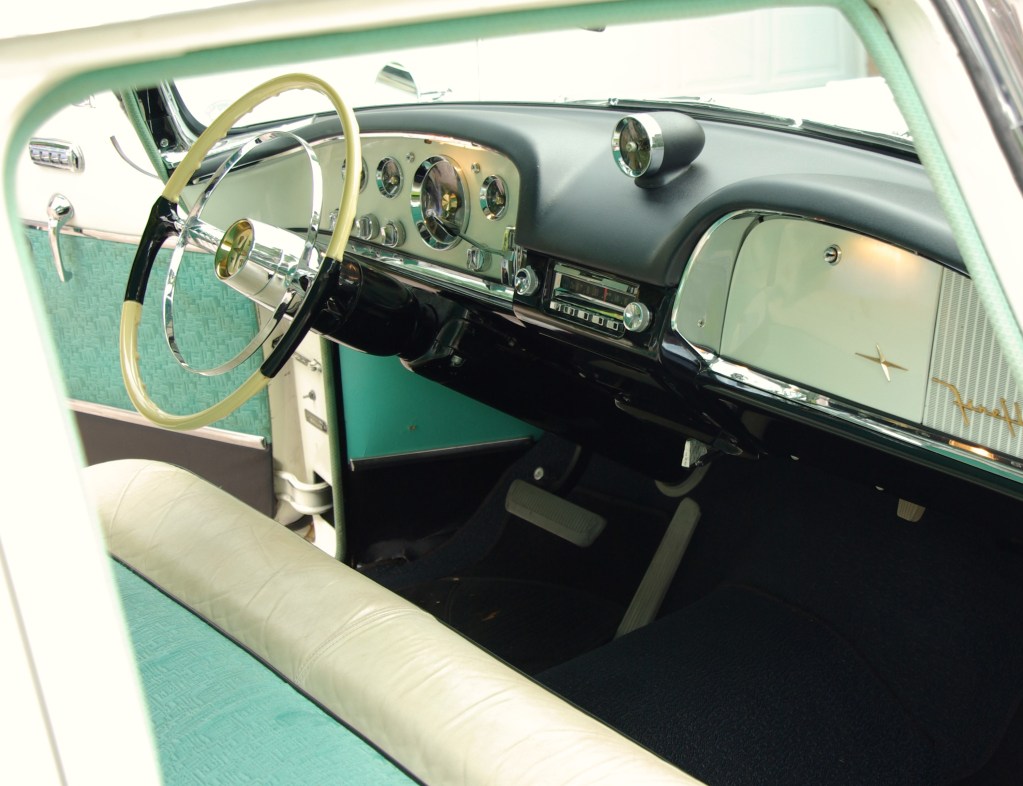
are some of this De Soto’s signature interior design features.
In their promotional literature, Chrysler’s public relations firm wrote: “Have you ever dreamed of a car so handsomely crafted, so distinctive in concept and color that it would stand out like a rare jewel? Then here is the car to fulfill your dream. . . the superlative, new De Soto Coronado.”
“A glamorous new three-tone color treatment, exciting and exclusive new fabrics created especially for the Coronado. No detail has been spared to bring you a car that is a distinction to own. . . a car to turn heads wherever you drive.” Although it wasn’t stated in the brochure, this tri-color package cost $172.
Just imagine for a minute that had Chrysler allowed De Soto to offer Coronado buyers a variety of other colors, and not just white/aqua/black, the many creative color combinations that would have resulted in such options would have been truly amazing, and vibrantly artistic.
In another brochure, De Soto stated: “Sculptured in long, low, sweeping lines, De Soto exterior design blends the best in traditional styling with an entirely fresh, modern inspiration. Its magnificently long hood slopes gracefully forward to give you a better view of the road ahead.” They went on to exclaim: “Lengthy (over 18 feet long) and low (barely reaches five feet) beautiful and powerful, here’s an open invitation to drive as you’ve never driven before. Big, family-size doors are gateways to roomy interiors brilliant in fabric, pattern and color . . .” By admiring the car in the photographs shown here, truer words have never been spoken. This truly is a magnificently poised automobile.

The Fireflite 291-cubic-inch V-8 puts out 200 horsepower at 4,400 RPM.
So, which powertrain lies under the Coronado’s hood that allows it to propel this 3,935 lb. sedan? De Soto offered two engines for the 1955 model year: The 185hp Firedome V-8 with a Carter BBD two-barrel carburetor was the base model engine that was fitted to all Firedome series cars, but this Coronado, like all Fireflite models, came with the more powerful Fireflite V-8 that produces 200 horsepower at 4,400 RPM thanks to its larger Carter WCFB four-barrel carburetor. Both engines, developed from the 1954-spec 276-cubic inch V-8, have a 7.5:1 compression ratio and are equipped with cast-iron cylinder heads incorporating hemispherical combustion chambers. Yes, this Coronado is Hemi-powered.
Spark is provided via a double-breaker distributor employing a vacuum-controlled automatic advance; it also features an insulating cover to prevent moisture-causing starting problems. The six-volt battery fitted to the De Soto was still common even in the mid-1950s; it had 120-amp capacity and was energized by a 45-amp generator. As antiquated as this system seems today, it worked reliably well with sufficient power.
The Coronado’s fully automatic two-speed PowerFlite transmission is simple to use thanks to its Flite Control lever. Just place the lever into drive, and off you go. Rear gear ratio is a 3.54:1, but two optional gear ratios were offered depending on the type of driving you preferred: 3.36 for more sedate Interstate travel or 3.73 for quicker getaways. And like all Fireflite models, power windows, four-way power seats, power steering and power brakes were all standard fare. To ensure maximum stopping performance, the four-wheel drum brake system employed six-wheel cylinders – two brake cylinders on each front wheel and one on each rear wheel.

Of the 26,637 Fireflite sedans produced, there’s no production breakout available as to how many were Coronado models. Exactly how many remain today is anyone’s guess, yet there’s no question that our feature car is one of the most original and authentic Coronado’s in existence. It resides in Palm City, Florida, in the hands of its long-time owner, Joe Hilton.
In his younger days, Joe had a 1955 De Soto but then sold it for the usual reasons of moving up to a newer car; it’s a decision he has always regretted. He purchased this Coronado in 2007 once he discovered it had never been restored. This is one of those rare cars that is as authentic as the day it rolled off the assembly line; it’s an incredibly honest example.
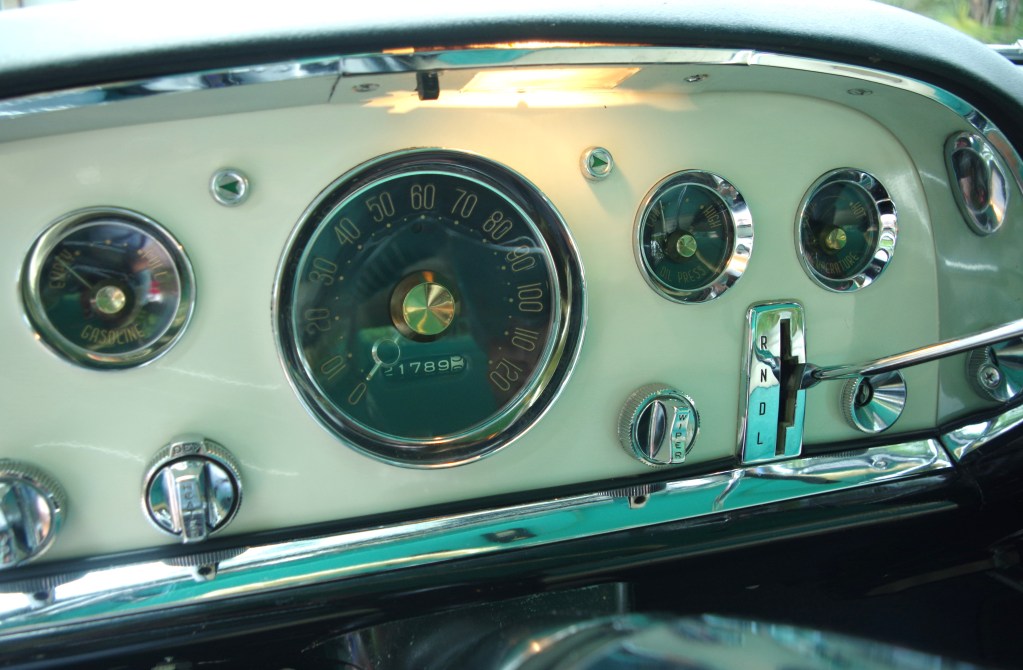
gear selector is conveniently located on the dashboard.
Looking back to those glory days of De Soto ownership, Joe told us: “When my wife and I were younger, we had a 1955 Firedome, which we really enjoyed owning. For years, I looked for a replacement, but they are fairly hard to find, especially ones that have been well taken care of. I knew the history of this Coronado and bought it from the second owner, who rarely drove it. He knew the car’s original owner, who also took extremely good care of it and always garaged it since it was new; it has been driving only 20,600 miles.”
So, what is it about 1955 De Sotos that Joe finds most appealing? “It’s the car’s flowing lines and its overall shape that I absolutely adore,” Joe said. “And all that beautiful chrome trim which contributes to the car’s charm. Most importantly, I love its tri-color paint scheme. All the period magazine ads show the Coronado with a green body and white side sweep panel, but mine is the opposite, and I like it better. I’m also partial to the symmetrical contour of the dash with the clock in the middle. I just think it’s a beautiful automobile with solid good looks.”
As to the Coronado’s road manners, Joe enthusiastically told us: “It’s really comfortable to drive. When I turn the steering wheel, I only need to use one finger; the steering is that effortless. It accelerates well enough in traffic, but it isn’t outstanding because of its two-speed automatic transmission. There’s no problem keeping up with traffic, but it doesn’t accelerate off the line quickly. The car just glides along, and the engine is very quiet. New brake cylinders and new brake shoes have been installed all around, so now it stops quickly and perfectly straight without any pulling.
Having owned two 1955 De Sotos over the course of several decades, Joe had this to say about this model’s reliability: “I’m always amazed at how easy the V-8 engine starts and how everything works so well. Noting ever goes wrong with it. It’s so well engineered and constructed. Best of all, I like that there’s so much window area. Although the roof is somewhat low, because they moved the A-pillar for the ‘55 models and went with a wraparound windshield, there’s plenty of unobstructed vision with all that glass area. But it’s the car’s incredible originality and the fact that it has never been taken apart that makes this Coronado so special; even the upholstery and headliner has remained in perfect condition.
“This De Soto is a real pleasure to drive.”
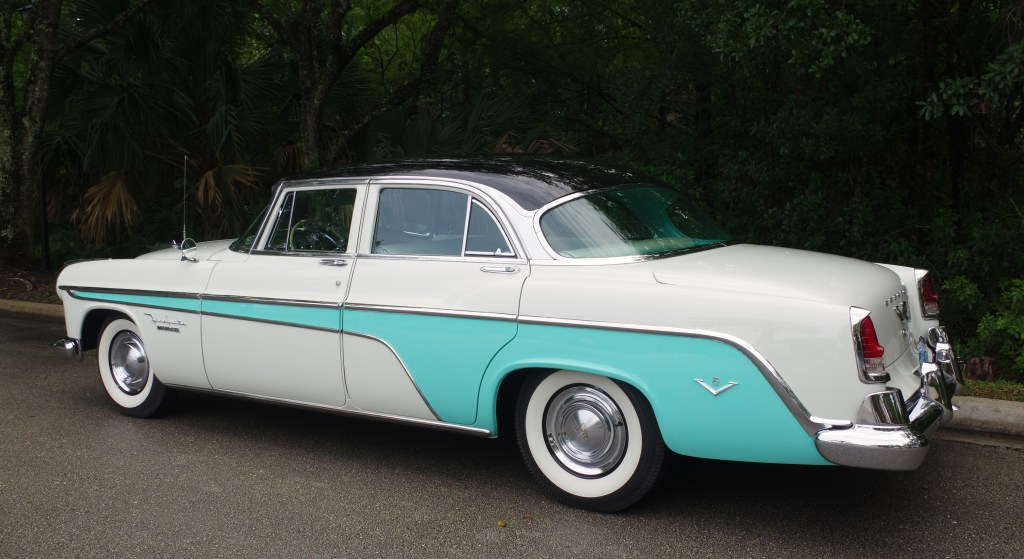
side sweep panel – truly sensational!