Old engines require zinc to prevent excessive wear on camshafts, lifters and other internal engine components. This is why.
By Mark Macy
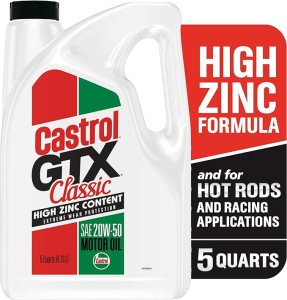
It’s been all over the automotive blogs, chat rooms, discussion groups, and print publications for many years now. The EPA has forced the reduction or elimination of ZDDP (Zinc Dialkyl-Dithio-Phosphate) from engine oil. Are there consequences for owners of vintage autos or is this just the latest version of ‘the sky is falling’?
Motor oil is one of those hot buttons that is always capable of starting a debate among car guys. Most gearheads have a particular brand of oil that they feel is the best and will debate the merits at length with anyone who doesn’t concur with their opinion.
But this latest debate among vintage car folks over ZDDP is widespread and touches everyone addicted to engines designed more than 30-plus years ago. You see, for most of the last century, the almost universal method to open and close engine valves was via flat tappets – solid or hydraulic lifters, and the ZDDP additive was mixed into oil to prevent or reduce wear between the lifters and the camshaft (see diagram below). But minute amounts of ZDDP in oil that is burned will exit through the exhaust system and shorten the life of catalytic converters. Thus, the EPA mandate to eliminate ZDDP from engine oil, and the auto makers have responded by designing engines that utilize roller lifters or overhead camshafts, which have no need for the protection offered by ZDDP.

Motor oil has carried a performance rating from the American Petroleum Institute (API) since the days of horseless carriages. Pick up any quality motor oil at your local auto parts store and you’ll see the API logo on the bottle. Automobile oils have a two-letter service designation, which always begins with the letter “S.” and then works its way down the alphabet for the second letter. Historically, the newest designations have always met the performance specifications of the previous ones, and so there was never an issue with using the latest technology motor oil in vintage cars, until now. While ZDDP levels have been gradually reduced starting with SG oils in 1988, it is the SM designated oil (and subsequent versions) with the nearly total elimination of ZDDP that has raised the concerns of all old car enthusiasts who both fear and suffer the consequences of their camshafts and lifters experiencing premature wear.
I was skeptical of all this doom and gloom talk at first. Then as I learned more about just what ZDDP is, and what it’s supposed to do, I remembered some Triumph engine problems that have been discussed in the past. The problems, which have been reported by several different individuals, were the rapid wear and almost total destruction of the camshaft and lifters in newly overhauled engines. Up to now, this problem has been blamed on ‘reproduction’ lifters, which are too ‘soft’ when tested on a Rockwell hardness tester. But now I’m starting to believe that this might have been the first appearance of a lubrication problem, and the new reproduction parts were the quickest and easiest place to lay the blame. Since the benefits of ZDDP are especially important during the break-in period for camshafts and lifters, it makes sense to me that the excessive wear and destruction of parts will show up in recently overhauled engines well before we see it in higher mileage engines.

So, now that I am starting to believe that this ZDDP thing could be a real problem, what can we do about it? There have been a number of possible “fixes” suggested already, but deciding on the best one is going to fall back on personal taste, providing even more fodder for oily discussions among motor heads. One quick solution that’s been suggested is to use a diesel motor oil that contains enough ZDDP to fend off the premature cam and lifter wear. But diesel motor oils carry completely different API ratings which begin with the letter “C,” and they also contain additive packs which were designed for the diesel’s unique characteristics, so they may not be totally appropriate for use in gasoline engines. You also cannot automatically assume that just any diesel oil contains enough ZDDP to provide adequate protection. To me, this is almost as scary as running our Triumphs without the ZDDP additive, so we won’t even consider this as an option.

In the wake of all the fears over potential engine damage, oil supplements containing ZDDP are showing up in catalogs and on store shelves in a big way. Each will claim to have just what your car needs, and only time will tell if they solve the problem or amount to nothing more than modern day snake oil. Without a performance rating system such as the API designations for oil, there is really no way to substantiate the claims of the manufacturers’ marketing departments until your engine lives another 10,000 miles or so without self destructing. I’m not willing to let any Macy’s Garage TR engine be the experimental test bed for these additives, but please be sure to let us know how it all works out in yours!
Another option is the specialty oils for classic and vintage cars that are available now. All of these I’ve seen so far list ZDDP as an ingredient, but most appear to be available only in multi-grade weights (viscosity) such as 10W-30 and 20W-50 so far. While this is going to be fine in engines of the mid 1960s and 1970s (such as six-cylinder TR engines), I haven’t had the best luck using them in inline-four TR engines from earlier times when the factory recommendations were for single weight oils.
The fourth and final option, and the one that we’ve decided to pursue here at Macy’s Garage, is to find some single weight gasoline engine oil that still contains adequate levels of ZDDP and meets an earlier API rating than the later SM rating. You’re probably not going to walk into the nearest AutoZone or Pep Boys and find this oil on the shelf, but it is still available if you do a little bit of digging.
I did a quick search on the NAPA auto parts website and found that I could search the engine oils by API ratings, brand, or by weight. I was delighted to find that for the straight 30W and 40W oils that I use in my Triumphs (and as recommended by the factory manuals), NAPA still carries SL, SJ, and SH oils in their own NAPA brand, as well as from Pennzoil, Quaker State, and Valvoline. You’ll have to get the part numbers from the website and then have your local NAPA store order a full case for you, but the peace of mind will more than make up for the small effort required to obtain it.
I’ve been a Valvoline guy for nearly 50 years now, so I was happy to find their VR1 racing oil with SL, SJ, SH ratings available from NAPA in both SAE30W and SAE40W, and I ordered a case of 30W to begin. When I picked it up from my local NAPA store, I was extremely happy to see “ZDDP additive provides tough anti-wear protection” on the outside of the case, and a similar statement on each bottle. We also use the VR1 racing oil in 20W50 for all the six-cylinder TR engines.

UPDATE: The confusion on this topic continues and as predicted, the debate rages on. While I did write this article based upon several published sources, more information has since surfaced which clouds the issue just a bit more. A call to the Valvoline tech number, shown on all of their oil bottles, and a discussion with a Valvoline engineer, revealed that the API designations do not necessarily tell the whole story on the ZDDP content of the oil. Some SM oils will still contain some ZDDP, and some of the earlier designations may not contain enough to protect our early design engines. So, the bottom line is that you should use the API ratings as a starting point in your search, and then if the oil bottle does not specifically mention ZDDP and the protection it provides for camshafts and lifters, place a call to the tech line shown on most bottles and confirm that you are getting what you think you are!
UPDATE: Now more than 15 years since this article was originally written, I am happy to report that we’ve been using the Valvoline VR1 racing oil with ZDDP in all of the 20-25 TR engines we rebuild each and every year, and to date we’ve not experienced a single camshaft or lifter failure in any of our engines. I will also add that we test run every engine we rebuild before shipment back to the owner or installation in a car here in our shop, and we do this so that we can perform a very specific camshaft break-in procedure during the first 30 minutes of operation. While it appears that we’ve found a good solution, we still aren’t taking any chances!
Editor’s note: Special thanks to Macy’s Garage, located in Tipp City, Ohio, who specialize in the restoration of Triumph TR sports cars (TR2, TR3, TR3A, TR4, TR4A, TR5, TR250 and TR6 only) and the rebuilding of TR engines, gearboxes, differentials and steering boxes. A 1961 TR4 that they recently performed a body-off restoration on is the only Triumph ever given a perfect 100-point score at a Triumph Register of America concours. For more details, go to: http://www.macysgarage.com