How Cadillac earned the title: Standard of the World
By Richard Lentinello
Glamorous styling, luxurious interiors and smooth, powerful drivetrains have long been the hallmark of Cadillac automobiles. Yet it was precision manufacturing techniques that bestowed Cadillac with the moniker: The Standard of the World. This wasn’t an exaggeration. During the early years of the 20th Century, no other car company produced automobiles with the same accuracy of machining and precise fitment of its components than Cadillac.
The Cadillac Automobile Company started building cars in 1903 in Detroit, Michigan, with quality of engineering being their number one goal. Its founding father was Henry Leland from Barton, Vermont. The son of a farmer, Leland was fascinated with engineering and the intricate workings of various machinery, especially farm equipment. He was particularly infatuated with precision machining practices that focused on extremely close tolerances. Inspecting the other automobiles being built at that time, he was critical of their machining methods and the inconsistencies that were the norm of the day. Leland’s dedication to accuracy bordered on the obsessive, and he insisted that the manufacturing of engines and automobile parts be to the tightest and most precise tolerances imaginable, the likes of which had never been seen in mass production up until that time.
Breaking out on his own, in 1910, the first company that Henry Leland founded was Leland & Faulconer, which manufactured transmissions for the Olds Vehicle Company. And just two years later, in 1902, along with a group of investors, he founded the Cadillac Automobile Company, which, as odd as it may seem, was the former Henry Ford Company.
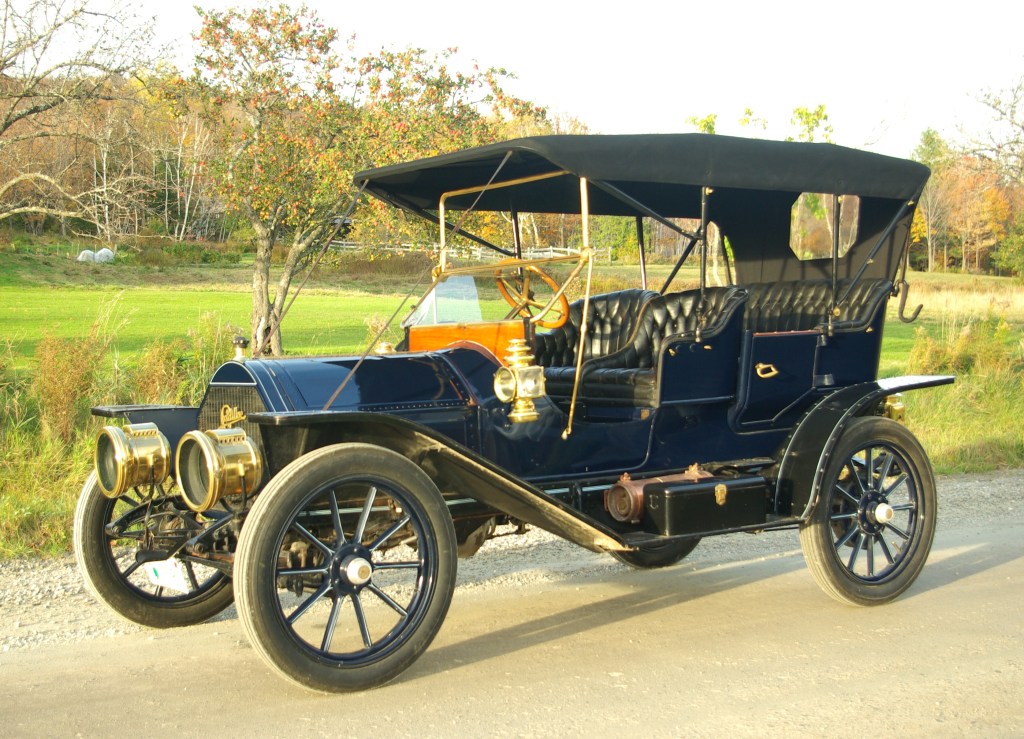
1909 Model 30 Demi-Tonneau
Leland named his company after the French explorer, Antoine de la Mothe Cadillac, who discovered the city of Detroit. After just one year, the first Cadillac automobile was introduced at the New York Auto Show. His designs and quality of production was so advanced compared to all the other automobiles on the market at that time, that during the 1904 New York Auto Show, the public were so impressed by the inherent quality of the Cadillacs on display, that more Cadillacs were sold at that show than any other automobile make in attendance.
However, it wasn’t until 1905, after Leland bought out his former partner Robert Faulconer, that the name of the company was changed to the Cadillac Motor Car Company. But what really put Cadillac on the map was when they won the DeWar Trophy in 1908. This high coveted prize was created by Britain’s Royal Auto Club in recognition of technical progress that was based on a standardization test which was performed in front of the public. At that time, car parts had to be individually sized to each individual automobile, with lots of hand-fitting of bearings and other precision components in order to achieve the desired specifications. Not so with Cadillac.
Leland’s steadfast commitment to precision machining tolerances proved that all Cadillacs could be assembled with parts interchanged from other Cadillacs without requiring any specific tailoring methods. He proved this in England when three Cadillacs were completely disassembled, their unmarked components mixed up, and the cars reassembled again, using only a small selection of basic hand tools. During this period, this was an astounding achievement which no other automobile manufacturer was able to accomplish. No one. Not even Rolls-Royce.
Not one to sit on their laurels, Leland and his talented team of engineers and designers continued the advancement of Cadillac automobiles by creating new technology that was unheard of at the time. In 1912, they introduced one of their most significant creations: the electric starter motor. Although the electric starter is something that now we all take for granted, in 1912, this was cutting-edge technology. No other car manufacturer offered electric starter motors on their automobiles – only Cadillac.
In the book 80 Years of Cadillac La Salle, author Walter McCall wrote: “In itself, automatic electric self-starting constituted an unprecedented breakthrough in automotive engineering. But when combined with improved ignition and electric lighting, all controlled from a centralized Delco electrical system, these remarkably advanced features immediately catapulted Cadillac far ahead of every other make of car in existence in sophistication and convenience. Electric self-starting took the industry by storm. Suddenly virtually every other car seemed old-fashioned by comparison.”
Thanks to Cadillac’s staff of pioneering engineers, the days of hand cranking an engine to start were clearly nearing an end, all, in part, due to their unwavering quest for engineering advancements. As a result, Cadillac was awarded a second DeWar Trophy, thus becoming the first automobile manufacturer to have ever received this prestigious award twice.
But wait, there were more innovations on the horizon!

In 1929, Cadillac fitted all of its cars with windshields and side windows made of safety glass, along with electric windshield wipers, and “silent” synchromesh transmissions. Then, to keep up with other prestigious marques like Packard, Cadillac introduced for the 1930 model year a V-16 engine. For those seeking exclusivity, the Series 542A model was the glamorous automobile designed specifically for their high-class demands.
Convincing potential buyers that this was the car for them, the company’s brochure stated: “The Cadillac sixteen-cylinder engine goes far beyond the contemporary conception of brilliant performance. It multiplies power and subdivides it into a continuous flow . . . constantly a full-volume efficiency. . . flexible. . . instantly responsive. This, plus complete individuality in styling, is – in brief – the story of the ‘V-16’.”
The mighty V-16 engine featured overhead valves and displaced 452 cubic inches and put out 175 horsepower. For 1938-’40 the V-16 was changed to an L-head design. Then for the 1930 model year, Cadillac introduced another special engine: a 368-cubic-inch V-12. Twelve-cylinder-equipped models were called Series 370A, and the 135-horsepower V-12 remained in production through the 1937 model year.

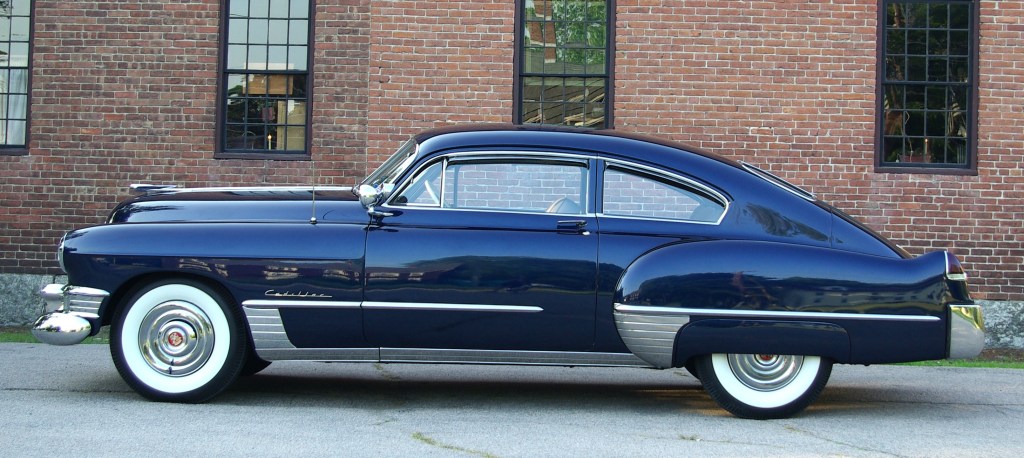
Cadillac’s matchless combination of quality, style, innovation and value was the key to the company’s growing success prior to World War II. This trend would continue in the postwar era when Cadillac announced its modern overhead-valve V-8 engine for the 1949 model year. This modern powertrain piloted a whole new era of innovation, thus reinforcing Cadillac’s reputation as the Standard of the World. Then came the fins!
The inspiration for the tailfin came from the World War II warbird, the Lockheed P38 fighter plane. When Harley Earl, head of GM’s Art & Colour department, and Frank Hershey saw a P38 at their local airfield, they were inspired to incorporate the plane’s tail shape into the rear fender of the forthcoming new 1948 Cadillac. Thus, a new era of tailfins was born.
If the tailfin wasn’t engaging enough visually, the Eldorado Brougham of 1957 certainly did the trick. With its polished stainless-steel roof, it was the ultimate showstopper of its time. Its body was completely crafted by hand, from the leading edge of the front fender’s shapely headlamp brow to the extreme tip of its quarter panel’s tailfin. Each of the 704 examples that were built during the 1957-’58 model years is an individually crafted masterpiece of metal. Name another car that came standard with six magnetized drinking cups, a cigarette case, a vanity compact with lipstick and cologne, and a rear seat compartment outfitted with a notepad and pencil, portable vanity mirror and a perfume atomizer filled with Arpege Extrait de Lanvin perfume. You will be hard pressed to find a more lavishly appointed automobile than the 1957-’58 Eldorado Brougham. No wonder each car cost more than $13,000!


1956 Convertible Sedan (top left), 1957 Biarritz (bottom left) and 1957 Convertible (bottom right)
As the years progressed, the Cadillac tailfin grew larger in size and more pronounced in shape. The first major revision was introduced on the 1957 models with a reversed angled tailfin. Then came 1959. If ever an automobile can be labeled iconic, the 1959 Cadillac would win hands down. Its tall, jet-like tailfin with twin bullet-shaped taillamps is an absolute marvel of creative styling at its extreme. No other automobile garners as much admiration or has as much presence as the ’59 Cadillac. None.


1958 Sedan de Ville (left), 1958 Convertible (center) and 1959 Series 63 Couple de Ville.
In September 1964, Cadillac introduced a more contemporary styled model. With its vertically stacked headlamps and the leading edge of the hood shaped with a prominent point, its modern look was quite captivating for its time. And with a massive 429-cubic-inch V-8 under the hood that belted out 340 horsepower, the 1965 Cadillac was also a blast to drive.
Two years later, Cadillac introduced to an unsuspecting public their latest technological creation: the front-wheel-drive Eldorado hardtop coupe. With its sharp, razor-edge styling and long, sleek shape, the Eldorado was a massive hit. The way it drove and handled was unlike any other full-size American automobile. It was the perfect car for those seeking a well-appointed personal luxury car, especially the 1970 model with Cadillac’s new and very powerful 500-cubic-inch V-8.

What made Cadillac such an outstanding car company was that they always pushed the envelope when it came to styling and design. They led; they didn’t follow. They created trends and pushed innovations to the limit. Proof positive came in the form of the 1980 to 1985 front-wheel-drive Seville.
With styling that took its inspiration from 1950s-era Rolls-Royces designed by England’s Hooper Coachbuilders, the rear end treatment, which is known as the bustleback, was one of those designs that people either loved or hated. Without question it’s a stylish and highly distinctive looking automobile, and easily stood out from the crowd wherever it went. Even today, its novel style still looks fairly contemporary.

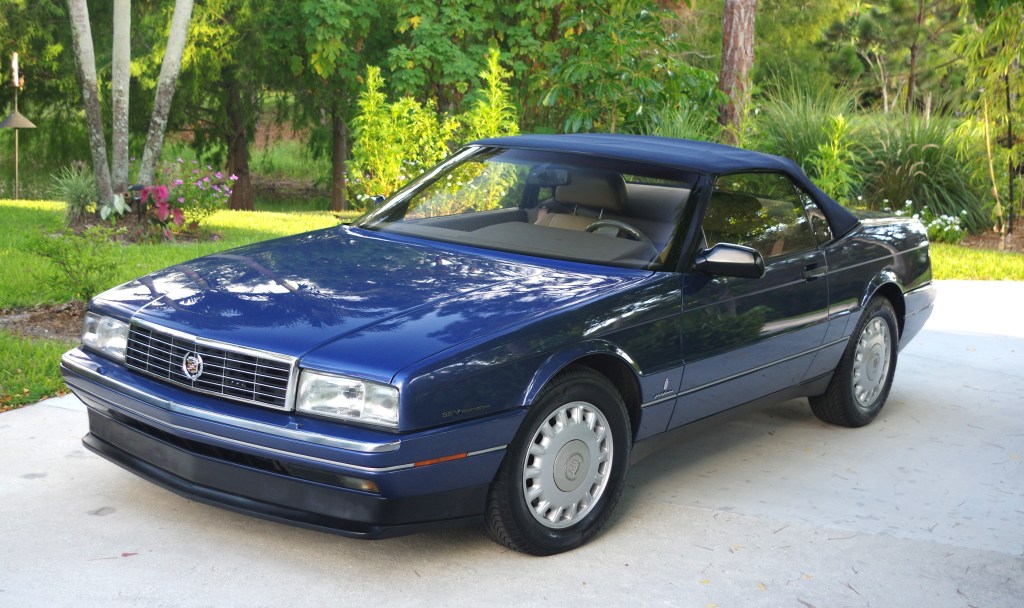
For the 1986 model year, Cadillac teamed up with Italian coachbuilder Pininfarina to create the Allante. With its sleek body handcrafted in Italy, then shipped to Detroit for final assembly, approximately 21,000 Allantes were produced during the car’s short seven-year production run, which ended in 1992. If ever there was a modern-day, mass-produced coachbuilt automobile, the Allante is it. During the past 119 years, Cadillac has produced so many important and historically significant automobiles that it will take a large book to include them all. Be it a Biarritz or a no-frills Series 62; a spacious Fleetwood Brougham or a powerful V-16; a prewar Sport Phaeton or a Town Sedan; the ever-popular coupe de Ville or a convertible; Cadillac offered a variety of models and body styles for every type of taste, desire, need and price point. And in today’s somewhat crazy collector-car marketplace, few automobiles offer the same level of quality, value and performance as an old Cadillac. Regardless of its year or model, or even its condition, driving a vintage Cadillac will make you feel special, and you’ll quickly realize why it’s been called the Standard of the World. No wonder people the world over have long desired to own a Cadillac before they die. They proudly want to prove to their family and friends that they have arrived. And when they pulled up to the house in a Cadillac, arrive they did.